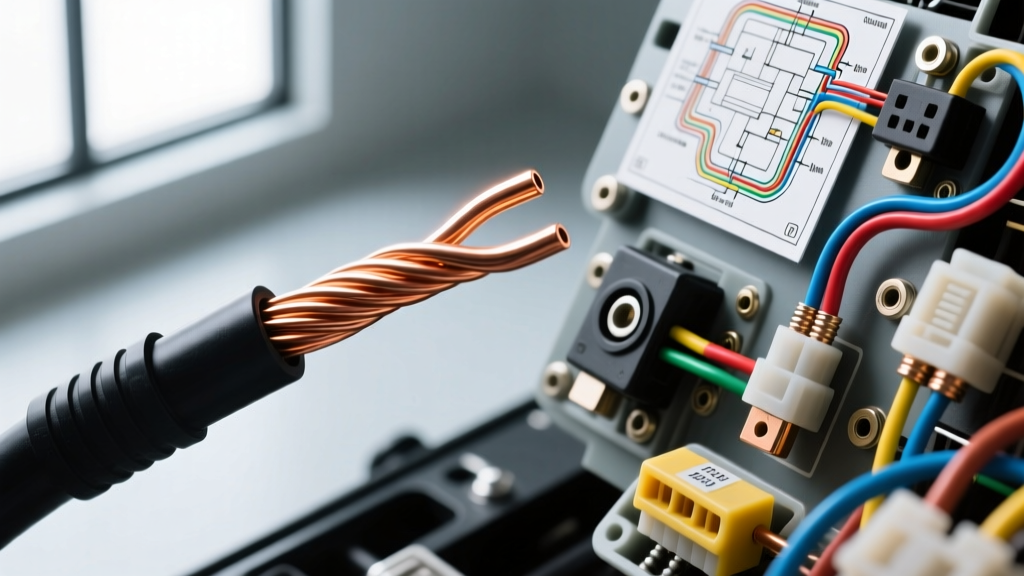
The Anomaly of 13 AWG in Automotive Systems
In the American Wire Gauge (AWG) system, standard automotive primary wire sizing follows a predictable logarithmic step: 16, 14, 12, 10, and 8 AWG. Odd-numbered gauges like 15, 13, and 11 AWG are virtually non-existent in standard North American commercial wiring spools. When a technician or DIYer encounters 13 gauge wire in an automotive harness, it is almost always the result of a misinterpretation of European metric wiring, a specialized OEM crossover application, or a dangerous substitution. Understanding the exact specifications, limitations, and common pitfalls of 13 AWG is critical for preventing electrical fires, voltage drop issues, and ECU damage in 12V and 24V vehicle systems.
Critical Mistake #1: Confusing Metric 2.5mm² with 13 Gauge Wire
The most frequent safety hazard involving 13 gauge wire stems from the false equivalence between AWG and metric cross-sectional area. Modern European vehicles (Volkswagen, BMW, Audi) adhere to ISO 6722 standards for road vehicle cables, which specify wire sizes in square millimeters (mm²). A common metric size is 2.5mm². Because 13 AWG has a cross-sectional area of roughly 2.62mm², many wiring charts incorrectly list 2.5mm² and 13 AWG as interchangeable. They are not.
Metric vs. AWG Cross-Sectional Area Breakdown
| Wire Standard | Nominal Size | Cross-Sectional Area | Standard Stranding | Max Fuse Rating (Open Air) |
|---|---|---|---|---|
| SAE AWG | 14 AWG | 2.08 mm² | 41 x 0.254 mm | 15A |
| SAE AWG | 13 AWG | 2.62 mm² | 41 x 0.287 mm | 18A |
| ISO 6722 Metric | 2.5 mm² | 2.50 mm² | 50 x 0.25 mm | 20A |
| SAE AWG | 12 AWG | 3.31 mm² | 65 x 0.254 mm | 25A |
The Safety Warning: If you repair a damaged 2.5mm² metric harness (often protected by a 20A Maxi fuse) using true 13 gauge wire, you are introducing a bottleneck. While the solid copper area is similar, the stranding geometry and insulation thermal properties differ. Always step up to 12 AWG when repairing 2.5mm² metric circuits to maintain the safety margin required by the OEM fuse rating.
Critical Mistake #2: Ignoring SAE J1128 Temperature Derating
Ampacity ratings found on generic wire spools are typically tested in open air at 25°C (77°F). However, automotive wiring is routed through bundled harnesses, behind hot exhaust manifolds, and inside engine bays where ambient temperatures routinely exceed 100°C. According to SAE J1128 specifications for Low Tension Primary Cable, wire insulation types like GPT (General Purpose Thermoplastic) and TXL (Thin-wall Cross-linked) must be heavily derated as heat increases.
SAE J1128 Ampacity Derating Chart for 13 AWG
| Ambient Temperature | Derating Factor | 13 AWG GPT Max Ampacity | 13 AWG TXL Max Ampacity |
|---|---|---|---|
| 25°C (77°F) | 1.00 | 18.0 Amps | 21.0 Amps |
| 60°C (140°F) | 0.75 | 13.5 Amps | 15.7 Amps |
| 85°C (185°F) | 0.50 | 9.0 Amps | 10.5 Amps |
| 105°C (221°F) | 0.33 | 5.9 Amps | 6.9 Amps |
| 125°C (257°F) | 0.15 | 2.7 Amps | 4.5 Amps |
Real-World Failure Mode: A common DIY mistake is using 13 gauge wire to power an aftermarket 12V radiator fan relay in the engine bay. The fan draws 14A on startup. In open air, 13 AWG handles this easily. However, routed near the radiator where ambient heat soaks to 85°C, the wire's capacity drops to 9.0A. The 15A inline fuse will not blow immediately, but the GPT insulation will soften, melt, and eventually short against the chassis, causing an electrical fire.
Critical Mistake #3: Voltage Drop on Oxygen Sensor Heater Circuits
Modern wideband oxygen sensors, such as the Bosch LSU 4.9, rely on internal heater circuits to reach operating temperature (approx. 750°C) rapidly. These heaters are high-current loads. On a standard 5-pin LSU connector, Pin 3 (Heater +, often White/Black wire) and Pin 4 (Heater -, often Grey wire) can draw 8A to 12A during cold engine cranking.
Because 13 gauge wire is an awkward, in-between size, it possesses a resistance of roughly 2.003 ohms per 1,000 feet. If a technician uses a 15-foot run of 13 AWG (30 feet total round-trip) to extend an O2 sensor harness, the voltage drop becomes significant.
Voltage Drop Calculation for 13 AWG (12V System)
- Formula: Voltage Drop = (Current x 2 x Length x Resistance per ft)
- 10 ft run (10A load): 0.40V Drop (Acceptable)
- 15 ft run (12A load): 0.72V Drop (Marginal - may trigger slow-heater DTCs like P0030)
- 20 ft run (12A load): 0.96V Drop (Critical - ECU will detect heater circuit failure)
The Fix: Never use 13 gauge wire for extended O2 sensor heater circuits. Always use 12 AWG (or OEM equivalent metric 2.5mm²) to ensure the ECU sees a minimum of 11.5V at the sensor heater pins during cold starts.
Crimping and Termination Failures
13 gauge wire falls into a dangerous 'dead zone' for standard automotive terminals. Most ratcheting crimpers and open-barrel terminals (like AMP Superseal 1.5 or Deutsch DT) are designed specifically for 14 AWG or 12 AWG.
- Using a 12 AWG Terminal: The wire will sit loosely in the crimp barrel. Under engine vibration, the wire will fatigue and snap, or create a high-resistance hotspot.
- Using a 14 AWG Terminal: The technician will be forced to trim away strands of the 13 AWG wire to make it fit into the smaller barrel. Trimming strands reduces the cross-sectional copper area, effectively downgrading the wire to 15 AWG at the crimp point, creating a bottleneck that will melt under load.
Expert Specification: If you must terminate true 13 AWG wire, use a dedicated crimp die calibrated for 2.5mm² to 3.0mm² wire, such as the Astro Tool 1170 or an equivalent IWISS die set. Ensure the crimp yields a bellmouth on both sides and passes a pull-test of at least 60 lbs.
Expert Verdict: When to Use (and Avoid) 13 Gauge Wire
In professional automotive electrical diagnostics and harness fabrication, 13 gauge wire should generally be avoided. The AWG standard is designed around even-numbered steps to provide clear, safe margins for fuse sizing and thermal derating. If you are repairing a harness and measure a wire that falls between 14 AWG and 12 AWG, it is almost certainly a metric 2.5mm² wire. For all repairs, substitutions, and aftermarket accessory wiring (such as fuel pump upgrades, lighting relays, and ECU power feeds), standardize your inventory to high-strand-count 12 AWG TXL or SXL wire. This ensures compatibility with standard automotive fuses, proper terminal crimping, and adherence to SAE safety margins across all engine bay temperature zones. For further reading on standard wire conversions, reference resources like Madsen Wire's conversion charts to verify your exact stranding requirements before cutting into any OEM harness.