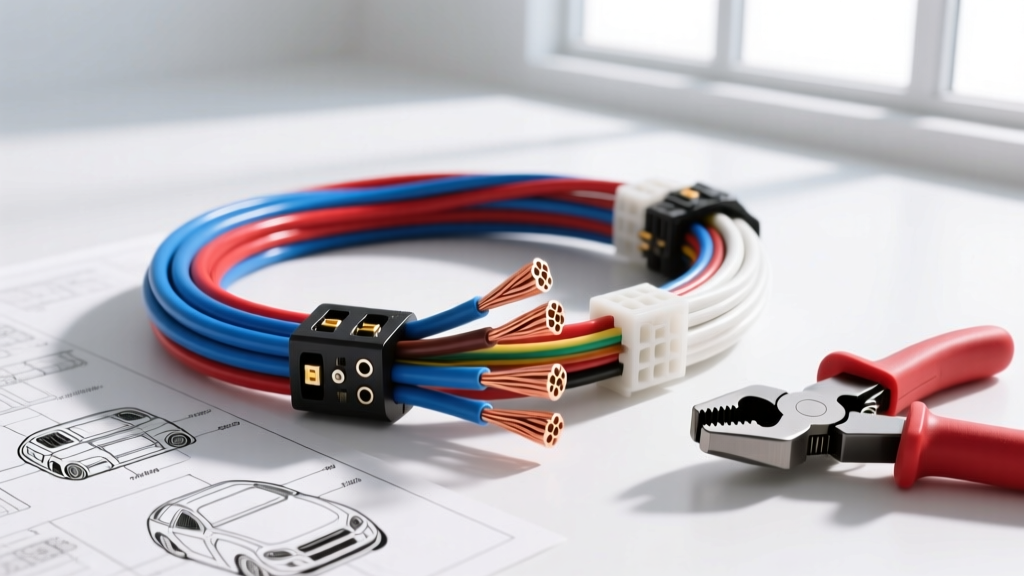
The Reality of 25 AWG in Automotive Harnesses
When building custom automotive wiring harnesses or repairing delicate ECU sensor circuits, selecting the correct wire gauge is paramount. While 18 to 12 AWG dominates power distribution, 25 gauge wire (AWG 25) occupies a highly specialized niche. With a nominal diameter of just 0.0179 inches (0.455 mm) and a cross-sectional area of 0.162 mm², 25 AWG is strictly reserved for low-current signal transmission, thermocouple extensions, and high-density ECU connector pinouts.
However, integrating 25 AWG into a vehicle’s electrical system introduces significant cost and tooling barriers. Unlike standard automotive primary wire (SAE J1128), 25 AWG requires specialized insulation materials to survive under-hood temperatures, and the tooling required to strip and crimp this micro-wire without severing the copper strands represents a major investment. This guide provides a comprehensive cost and tooling analysis for professionals and advanced builders considering 25 AWG for motorsport and precision sensor applications.
Material Cost Breakdown: PTFE vs. PVC vs. Magnet Wire
The first hurdle in sourcing 25 gauge wire is navigating the insulation types. Standard PVC-jacketed wire is inadequate for under-hood automotive environments, as it becomes brittle and melts near exhaust manifolds or high-heat engine components. Therefore, automotive 25 AWG is almost exclusively manufactured with PTFE (Teflon) or cross-linked polyethylene (XLPE) insulation, often conforming to MIL-W-16878 or SAE AS22759 specifications.
The Magnet Wire Trap
A common and catastrophic mistake made by novice builders is purchasing enameled copper magnet wire in 25 AWG due to its low cost (often under $0.05 per foot). Magnet wire lacks a protective polymer jacket and its enamel coating will instantly fail under automotive vibration, leading to short circuits against the chassis or adjacent signal wires. Magnet wire should never be used for automotive sensor routing.
Cost Comparison Matrix
Below is a cost and specification comparison for 25 AWG against its more common neighbors, 22 AWG and 24 AWG, utilizing mil-spec PTFE insulation.
| AWG Size | Stranding | Resistance (Ω/1000ft) | Insulation Type | Est. Cost (per ft) |
|---|---|---|---|---|
| 22 AWG | 19/34 | 16.14 | PTFE / Tefzel | $0.45 - $0.70 |
| 24 AWG | 19/36 | 25.67 | PTFE / Tefzel | $0.65 - $0.95 |
| 25 AWG | 7/33 or Solid | 34.42 | PTFE / MIL-Spec | $1.20 - $2.50 |
As the table illustrates, the cost per foot for genuine 25 AWG PTFE wire is substantially higher. This is due to lower manufacturing volumes and the precision required to extrude thin-walled Tefzel insulation over micro-stranding without compromising the dielectric strength.
The Hidden Expense: Micro-Tooling Requirements
The material cost of 25 gauge wire is only a fraction of the total investment. The true financial barrier lies in the tooling. Standard wire strippers and automotive crimpers will destroy 25 AWG wire, either by nicking the copper strands (creating a high-resistance failure point) or by crushing the micro-crimp barrels.
Precision Stripping Solutions
Mechanical blade strippers are highly risky for 25 AWG. The insulation thickness on mil-spec PTFE 25 AWG is often just 0.006 inches. A standard stripper blade will inevitably score the copper, leading to immediate wire fatigue and breakage under engine vibration. Professionals rely on two methods:
- Thermal Wire Strippers: Tools like the ERSA Thermopulz use a heated element to melt the PTFE insulation away without touching the copper. These units cost between $350 and $600 but guarantee zero strand damage.
- Precision Micro-Strippers: High-end mechanical strippers with laser-calibrated blades (such as those from Jokari or Knipex) can be used, but they require frequent recalibration and cost upwards of $120 per pair.
Ratcheting Micro-Crimpers and Die Selection
Crimping 25 AWG requires micro-dies that apply exact radial pressure to the connector barrel. According to TE Connectivity application specifications, an under-crimped 25 AWG wire will pull out under minimal tension, while an over-crimped wire will shear the 7-strand copper core, reducing the cross-sectional area and causing a voltage drop.
To properly terminate 25 AWG into high-density ECU connectors (like the Bosch MS6.4 or Molex Pico-EZmate series), you must invest in a ratcheting micro-crimper with interchangeable die sets. A baseline ratcheting frame costs around $250, while the specific die cavity for 0.162 mm² (AWG 25) wire costs an additional $150 to $300. This brings the minimum tooling entry price to over $500 before a single wire is terminated.
Real-World ECU Pinouts and Sensor Integration
Where is 25 AWG actually mandated in automotive systems? It is primarily found in high-density motorsport ECU harnesses where connector real estate is limited, and in specific low-amperage sensor circuits.
Bosch Motorsport ECU Applications
In professional motorsport, ECUs like the Bosch MS6.4 utilize high-density connectors where 25 AWG is frequently specified for low-load signal wires to save weight and harness bulk. For example:
- Pins 14 & 15 (CAN-H / CAN-L): While CAN bus can handle 22 AWG, 25 AWG PTFE twisted pair is often used in aerospace and top-tier motorsport to reduce harness weight, provided the total run length does not exceed the voltage drop threshold for the transceiver's common-mode range.
- Thermocouple Extensions: Type K thermocouple signal wires (Yellow/Red) are frequently sourced in 25 AWG solid or 7-strand to match the micro-pins on EGT (Exhaust Gas Temperature) amplifier modules.
When working with these pinouts, it is critical to follow Bosch Motorsport wiring guidelines, which dictate that any 25 AWG signal wire must be shielded and the shield drain wire must be grounded at the ECU backshell only, preventing ground loops that would otherwise distort the micro-voltage signals carried by the 25 AWG core.
Failure Modes: Vibration, Voltage Drop, and Shearing
Working with 25 gauge wire introduces unique failure modes that standard automotive diagnostics often miss. Understanding these is crucial for troubleshooting intermittent sensor faults.
Micro-Fractures from Vibration Fatigue
Because 25 AWG is so thin, it lacks the mechanical tensile strength to withstand engine bay vibration if the harness is not properly secured. If a 25 AWG wire is used to bridge a sensor without adequate strain relief or loom support, the copper strands will work-harden and snap inside the insulation. The wire will look perfect on the outside, but the multimeter will read an open circuit. Fix: Always use heat-shrink tubing with integrated adhesive lining and secure the micro-wire to a larger 'carrier' wire or braided loom within 1 inch of the crimp.
Connector Backshell Torque Issues
When terminating 25 AWG into cylindrical multi-pin connectors (like Deutsch DTM size 20 contacts), the rear insertion/extraction tool must be used carefully. Forcing a 25 AWG wire into the grommet without proper chamfering of the wire tip will cause the wire to buckle inside the connector body, leading to a short against adjacent pins. Furthermore, the connector backshell must be torqued to the manufacturer's specification (typically 1.5 to 2.0 Nm for micro-autosport connectors) to ensure the internal grommet compresses and grips the thin 0.455mm OD jacket.
Voltage Drop Calculations
At 34.42 ohms per 1,000 feet, 25 AWG is highly susceptible to voltage drop. While it is fine for a 5V reference signal drawing 10mA, it cannot be used for active solenoids or heated oxygen sensor circuits. A 10-foot round trip of 25 AWG carrying just 1 Amp will result in a 0.34V drop, which is enough to trigger an ECU under-voltage fault code on sensitive 5V logic circuits. For a deeper understanding of wire resistance limits, refer to the SAE J1128 standard documentation regarding low-tension cable specifications.
Expert Verdict: Is 25 AWG Worth the Investment?
From a cost and tooling perspective, 25 gauge wire is an expensive, high-maintenance material. For 95% of automotive restorations, street builds, and basic aftermarket EFI installations, stepping up to 22 AWG or 24 AWG is highly recommended. The slight increase in harness weight and bulk is vastly offset by the ability to use standard, affordable crimping tools and the improved mechanical durability of thicker copper stranding.
However, if you are building a top-tier FIA-spec motorsport harness, repairing a high-density OEM ECU connector where 22 AWG physically will not fit into the micro-cavity, or routing specialized thermocouple telemetry, 25 AWG PTFE wire is mandatory. In these scenarios, the $500+ investment in thermal strippers and ratcheting micro-dies is not just a cost—it is an absolute requirement for reliability and safety on the track.