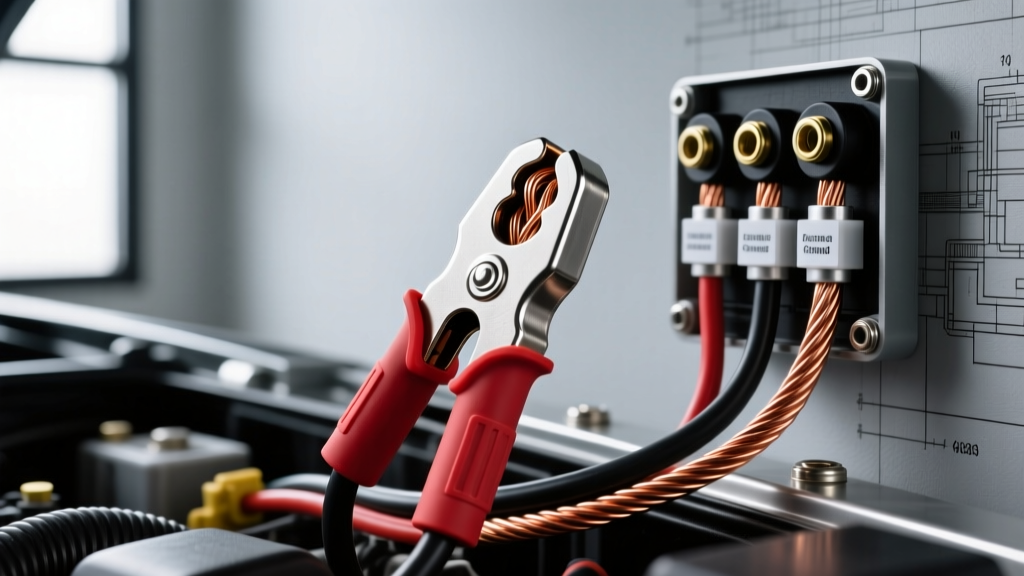
Introduction to 4 AWG High-Amperage Connections
When routing high-current circuits—such as winch feeds, aftermarket high-output alternator upgrades, EV battery banks, or competition car audio systems—selecting the correct 4 gauge wire connector is just as critical as the wire itself. A 4 AWG cable is capable of carrying massive electrical loads, but the connection point is universally the weakest link in any DC electrical system. Improper connector selection or termination at this gauge leads to increased resistance, localized heat generation, and catastrophic voltage drop under load.
This guide compares the primary 4 gauge wire connector types used in automotive and marine applications, detailing their specific use cases, material compositions, and termination requirements. Whether you are wiring a 12,000 lb winch on a Jeep Wrangler or upgrading the charging wire on a 2015+ Ford F-150, understanding connector architecture will ensure your high-amp circuits operate safely and efficiently.
4 Gauge Wire Specifications & Ampacity Baseline
Before selecting a connector, it is vital to understand the physical dimensions and current-carrying capacity of 4 AWG wire. Connector barrels and crimp dies are machined to specific tolerances; using a connector meant for standard 4 AWG stranding on a high-strand-count welding cable will result in a loose, high-resistance crimp.
| Specification | Standard Automotive (SAE J1128) | Marine/Welding (SAE J378 / UL 1581) |
|---|---|---|
| Stranding Count | 133 / 0.0100" | 420 / 0.0126" (Ultra-Flex) |
| Nominal OD (Conductor) | 0.232" (5.89 mm) | 0.258" (6.55 mm) |
| Cross-Sectional Area | 21.15 mm² | 21.15 mm² |
| Circular Mils | 41,740 cmil | 41,740 cmil |
| Max Ampacity (Single Wire) | 85 Amps | 150 Amps |
| Resistance @ 20°C | 0.2485 Ω / 1000 ft | 0.2485 Ω / 1000 ft |
Note: Always verify whether your 4 AWG wire is standard automotive primary wire or high-strand-count welding/marine wire. High-strand wire requires a slightly larger connector barrel diameter to accommodate the increased outer diameter of the copper bundle.
Comparing 4 Gauge Wire Connector Types
The term '4 gauge wire connector' encompasses several distinct terminal styles, each engineered for a specific mechanical and electrical environment. Below is a comparison of the four most common types.
1. Heavy-Duty Ring Terminals & Lugs (Battery & Starter)
Ring terminals are the standard for terminating 4 AWG wire to battery posts, starter solenoids, and grounding studs. For high-amperage applications, you must use heavy-wall, seamless copper lugs rather than stamped, open-barrel terminals.
- Material: Pure copper (ETP 110) with an electro-tinned finish to prevent oxidation.
- Stud Sizes: Commonly available in 5/16", 3/8", and 1/2". A 3/8" stud is standard for most OEM battery side-posts and starter solenoids (e.g., GM LS-series starters).
- Torque Specs: When mating a 4 AWG ring terminal to a 3/8" steel stud, the target torque is typically 10-12 ft-lbs. Over-torquing can stretch the copper barrel or strip the solenoid threads.
- Best Application: Alternator output upgrades, starter motor feeds, and main chassis grounds.
2. Inline Butt Splices (Cable Extensions & Repairs)
When extending a 4 AWG cable or repairing a section damaged by heat or abrasion, inline butt splices are required. For 4 AWG, step-down butt splices (which accept 4 AWG on one end and 2 AWG on the other) are frequently used by professionals to transition from standard wire to heavier welding cable near the battery.
- Insulation: Must utilize dual-wall, adhesive-lined polyolefin heat shrink with a 3:1 shrink ratio. The inner meltable adhesive seals out moisture and prevents capillary action from drawing water into the copper strands.
- Best Application: Winch cable extensions, routing power through firewalls, and EV battery module interconnects.
3. High-Current Quick Disconnects (Anderson SB Plugs)
For circuits that require frequent disconnection—such as removable winches, trailer towing, or modular EV battery packs—Anderson Powerpole SB175 connectors are the industry standard. While standard Powerpoles max out at 50A, the SB175 housing accepts 4 AWG wire and is rated for 175 continuous amps.
- Contact Resistance: Under 0.0002 ohms per pole when properly crimped.
- Architecture: Genderless housing design with stainless steel leaf springs to maintain constant contact pressure, mitigating the effects of thermal expansion and vibration.
- Best Application: Front-mounted winch quick-disconnects, portable jump-start packs, and marine shore-power tie-ins.
4. Distribution Blocks (Audio & Accessory Power)
Distribution blocks allow a single 4 AWG main feed to be split into multiple smaller circuits (e.g., splitting a 4 AWG main into two 8 AWG runs for amplifiers).
- Material Warning: Avoid CNC-machined aluminum distribution blocks when using copper 4 AWG wire. The dissimilar metals, combined with the presence of electrolytes (road salt, humidity), will cause rapid galvanic corrosion. Always select brass or tinned-copper distribution blocks for automotive environments.
- Best Application: High-end car audio power distribution, auxiliary fuse block feeds on overland vehicles.
Crimping vs. Soldering: The 4 AWG Debate
A common misconception among amateur automotive electricians is that soldering high-amperage connections provides a superior bond. In the context of 4 AWG wire connectors, soldering is strongly discouraged as a primary termination method. The American Boat & Yacht Council (ABYC) E-11 standard explicitly prohibits solder-only connections in high-vibration environments.
When you apply solder to a 4 AWG connector, the molten tin/lead alloy wicks into the copper strands via capillary action. This creates a rigid, inflexible section of wire immediately behind the connector barrel. In an automotive environment characterized by engine harmonics, chassis flex, and thermal cycling, this stiff transition point becomes a stress riser. Over time, the copper strands will work-harden and fracture just outside the solder joint, leading to a sudden, catastrophic open circuit.
Furthermore, solder has a significantly higher electrical resistance than copper and a much lower melting point. In the event of a short circuit or massive current spike (such as a winch stall), a soldered joint can melt and fail before the main mega-fuse blows. A properly executed mechanical crimp creates a 'cold weld'—a gas-tight, molecular bond between the copper wire and the connector barrel that maintains flexibility and handles thermal spikes far better than solder.
Common Failure Modes & Troubleshooting Matrix
Even with the correct 4 gauge wire connector, improper installation techniques will lead to circuit failure. Use this diagnostic matrix to identify and correct common high-amp termination issues.
| Symptom | Root Cause | Corrective Action |
|---|---|---|
| Melted or discolored heat shrink over the crimp barrel. | High resistance crimp due to undersized die or incomplete ratchet cycle. | Cut off terminal. Use a calibrated hydraulic crimper with the exact die matching the wire/connector combo. Perform a pull-test. |
| White/green powdery crust around the ring terminal stud. | Galvanic corrosion from mating bare copper to aluminum/steel without isolation. | Clean stud with a wire brush. Apply a thin layer of dielectric grease or dedicated anti-corrosion compound (e.g., Noalox) before torquing. |
| Wire strands splaying out of the back of the lug barrel. | Wire was not stripped cleanly, or the connector barrel was too short for the high-strand-count welding cable. | Use a rotary wire stripper. If strands splay, the connector is undersized for the specific wire class. Upgrade to a 'large barrel' lug. |
| Voltage drop exceeds 0.5V under heavy load (e.g., winching). | Micro-gaps inside the crimp barrel allowing oxidation, or using stamped (non-seamless) terminals. | Replace stamped terminals with heavy-wall, seamless drawn copper lugs. Verify crimp tool tonnage. |
Tooling Requirements for 4 AWG Connectors
You cannot reliably crimp a 4 gauge wire connector with standard handheld pliers. The cross-sectional area of 4 AWG copper requires immense mechanical force to compress the heavy-wall copper barrel into the strands, eliminating all air pockets to prevent internal oxidation.
- Hydraulic Crimpers (4 to 6-Ton): The preferred tool for 4 AWG lugs and butt splices. Hydraulic crimpers utilize hexagonal or nested-indent dies that compress the barrel uniformly from all sides, yielding a symmetrical, gas-tight cold weld.
- Heavy-Duty Ratchet Crimpers: Acceptable for production environments or tight engine bays where a hydraulic pump cannot fit. Ensure the tool features a full-cycle ratchet mechanism that prevents the jaws from opening until the exact required tonnage is reached.
- Die Selection: Never guess the die size. A die marked '4' on one manufacturer's tool may correspond to a completely different cross-sectional area on another. Always match the die to the specific SAE J1128 or AWG specification stamped on the connector barrel.
Summary
Selecting the right 4 gauge wire connector requires matching the terminal style to the mechanical demands of the circuit, verifying the wire stranding class, and utilizing the correct hydraulic tooling. By prioritizing heavy-wall tinned copper lugs, adhesive-lined heat shrink, and genderless high-current quick disconnects, you ensure your high-amperage automotive systems remain reliable, safe, and resistant to the harsh realities of under-hood and under-carriage environments.