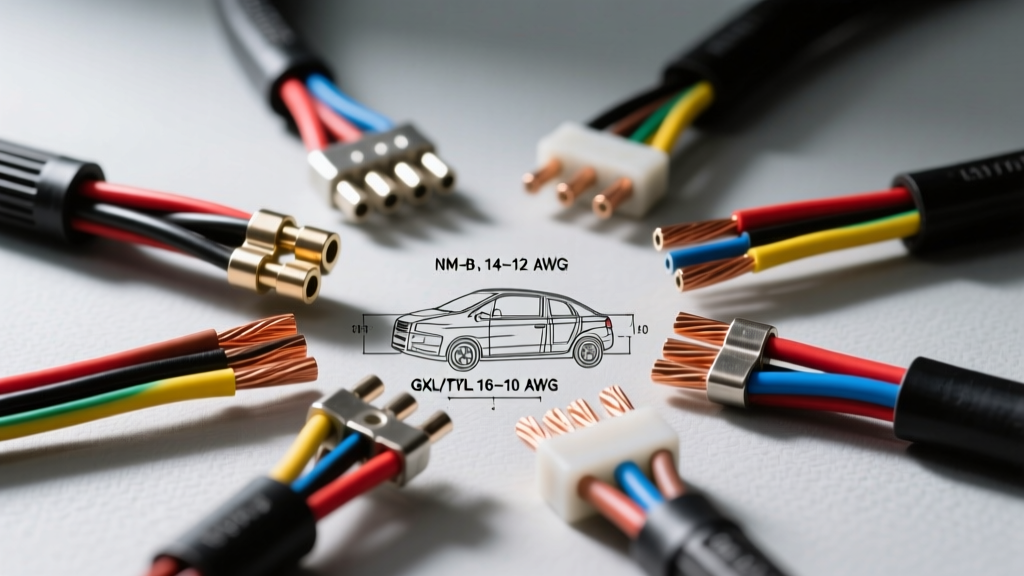
Understanding the Baseline: What Gauge Wire Is Used in Homes?
When DIY enthusiasts, off-road builders, and automotive restorers ask, 'what gauge wire is used in homes,' they are usually looking for a baseline to apply to their 12-volt vehicle projects. Residential wiring in North America is strictly governed by the National Electrical Code (NEC), specifically NFPA 70. In a standard household, wire gauge is determined by the amperage of the circuit breaker and the 120V/240V alternating current (AC) environment.
However, applying residential electrical logic to an automotive direct current (DC) system is one of the most common—and dangerous—mistakes made by beginner fabricators. While the American Wire Gauge (AWG) measurement system remains constant across both industries, the physical construction, insulation chemistry, and voltage drop calculations are radically different.
Standard Residential Wire Gauges (NEC Baseline)
In home construction, electricians primarily use NM-B (Non-Metallic Sheathed Cable), commonly known by the brand name Romex, or individual THHN/THWN-2 wires pulled through conduit. Because household voltage is high (120V to 240V), the amperage draw for standard appliances is relatively low, allowing for thinner wires.
| AWG Size | Breaker Rating | Common Home Application | Wire Type |
|---|---|---|---|
| 14 AWG | 15 Amps | Lighting circuits, bathroom fans | NM-B (Solid Copper) |
| 12 AWG | 20 Amps | Kitchen receptacles, general outlets | NM-B (Solid Copper) |
| 10 AWG | 30 Amps | Electric water heaters, window AC | NM-B / THHN |
| 8 AWG | 40 Amps | Electric ranges, HVAC compressors | NM-B / THHN |
| 6 AWG | 55 Amps | Sub-panels, large electric ovens | NM-B / THHN |
The Fatal Flaw: Solid Core vs. Stranded Automotive Wire
The most critical distinction between home and auto wiring is the conductor stranding. Residential NM-B and THHN wires are almost exclusively solid core—a single, thick cylinder of copper. Solid wire is cheap to manufacture, easy to strip, and pushes neatly into residential backstab receptacles or Wago lever-nuts.
However, solid core wire is entirely unsuitable for automotive applications. Vehicles are subjected to constant chassis vibration, engine harmonics, and thermal cycling. Under these conditions, solid copper work-hardens, fatigues, and eventually snaps inside the insulation, leading to intermittent shorts or total circuit failure. Furthermore, solid wire lacks the flexibility required to route through tight firewall grommets, door jambs, and steering column hinges.
Automotive wire, governed by SAE J1128 standards, uses multi-strand copper. For example, a standard 16 AWG automotive primary wire contains 26 individual strands of 30 AWG copper. This stranding provides the necessary flexibility and vibration resistance to survive the harsh environment of a moving vehicle.
Insulation Chemistry: PVC vs. Cross-Linked Polyethylene
When researching what gauge wire is used in homes, you will encounter THHN (Thermoplastic High Heat-resistant Nylon-coated) insulation. THHN is rated for 90°C in dry locations and is perfectly safe inside a climate-controlled wall cavity.
Under the hood of a vehicle, ambient temperatures routinely exceed 100°C near the exhaust manifolds, and the wire is exposed to battery acid, brake fluid, and abrasive debris. Automotive wiring relies on Cross-Linked Polyethylene (XLPE) insulations, specifically categorized as GXL, TXL, and HDT.
- GXL (General Cross-Linked): Standard wall thickness, rated up to 125°C. Ideal for general chassis routing.
- TXL (Thin-wall Cross-Linked): Thinner insulation, saving weight and increasing flexibility while maintaining the 125°C rating. The preferred choice for modern OEM harnesses and tight loom routing.
- HDT (Heavy Duty Thermoplastic): Thicker PVC-based insulation, used where extra physical abrasion resistance is required, though less heat tolerant than XLPE.
The 12-Volt Multiplier: Why Cars Need Thicker Wire
The fundamental reason you cannot use home wire gauge charts for automotive projects comes down to Ohm's Law and the Power Equation (Power = Voltage x Current). Because automotive systems operate at a nominal 12V (or 24V in heavy trucks), they must draw significantly higher amperage to achieve the same wattage as a 120V household circuit.
Consider a 120-watt device:
- In a Home (120V AC): A 120W lightbulb draws exactly 1 Amp. You could theoretically power this with a microscopic wire, but the NEC mandates a minimum of 14 AWG for the structural integrity of the 15A circuit.
- In a Vehicle (12V DC): A 120W LED off-road light bar draws 10 Amps. If you run this 15 feet from the battery, using 14 AWG wire will result in a voltage drop of nearly 0.4V. While acceptable for a light, if you scale this up to a 1200W car audio amplifier, the system will draw 100 Amps. Running 100A through residential 10 AWG wire (rated for 30A at home) will melt the insulation and start an engine bay fire in seconds.
Automotive AWG Ampacity and Voltage Drop Reference
Automotive ampacity ratings differ from the NEC. Because automotive harnesses are often bundled tightly (reducing ambient cooling) and must maintain strict voltage delivery to sensitive ECU modules, the acceptable ampacity is lower per gauge size, and voltage drop must be kept under 3% (0.36V on a 12V system).
| Auto AWG | Max Continuous Amps (Chassis) | Max Amps (Engine Bay 125°C) | Typical Automotive Application |
|---|---|---|---|
| 18 AWG | 6A | 4A | ECU sensors, low-draw LED markers, radio memory |
| 16 AWG | 10A | 8A | Interior dome lights, horn relay triggers, tail lights |
| 14 AWG | 15A | 12A | Headlight low beams, power window motors, fuel pumps |
| 12 AWG | 20A | 17A | High-beam headlights, accessory power outlets, ABS modules |
| 10 AWG | 30A | 23A | Radiator cooling fans, power seats, main ECU feeds |
| 8 AWG | 50A | 40A | High-output alternator feeds, EV battery management relays |
| 4 AWG | 120A | 100A | Main starter battery cables, mega-fuse distribution blocks |
Termination: Why Wire Nuts Fail in Vehicles
In home wiring, circuits are joined using wire nuts (Marettes) or push-in connectors like Wagos. These rely on the rigidity of solid copper wire to maintain spring tension and electrical contact. If you attempt to use a wire nut on stranded automotive wire, the soft strands will compress, deform under thermal expansion, and eventually loosen due to vibration. This creates a high-resistance joint, leading to arcing and localized melting.
Automotive electrical systems require mechanical crimping. Professional automotive harnesses use open-barrel or closed-barrel terminals (such as Delphi/Packard Metri-Pack or TE Connectivity Superseal connectors) applied with precision ratchet crimpers. According to USCAR-2 standards, a proper crimp on a 16 AWG terminal must withstand a minimum pull force of 30 lbs without the wire slipping, while simultaneously achieving a millivolt drop of less than 5mV across the joint.
For aftermarket repairs and custom looms, adhesive-lined heat shrink terminals are mandatory. The inner layer of hot-melt adhesive seals the stranded wire against capillary action, preventing moisture and battery acid from wicking under the insulation and causing green copper oxidation (verdigris) down the length of the wire.
Troubleshooting Voltage Drop in 12V Restorations
When upgrading older vehicles (such as classic 1970s muscle cars or early 80s trucks) that originally utilized marginal 14 AWG or 16 AWG wiring for headlights, owners frequently complain of dim halogen bulbs. This is not a ground issue; it is a voltage drop issue caused by undersized wire over long distances.
The Fix: Install a headlight relay harness. By running a dedicated 10 AWG feed wire directly from the battery (via a 30A MAXI fuse) to a pair of 4-pin Bosch-style relays mounted in the engine bay, you bypass the 40-year-old factory dash wiring. The factory 18 AWG wires are then repurposed solely as low-amp trigger signals for the relay coils, eliminating voltage drop and delivering a full 13.8V to the headlight bulbs.
Sources and Technical References
- National Fire Protection Association (NFPA 70): National Electrical Code (NEC) Article 310 - Ampacity tables for residential solid copper conductors.
- SAE International J1128 - Standard for Low Tension (Primary) Cable for surface vehicle electrical systems, covering GXL/TXL insulation specs.
- USCAR-2 Performance Specification - Automotive Electrical Connector Performance Standards, detailing crimp pull-force and millivolt drop testing.