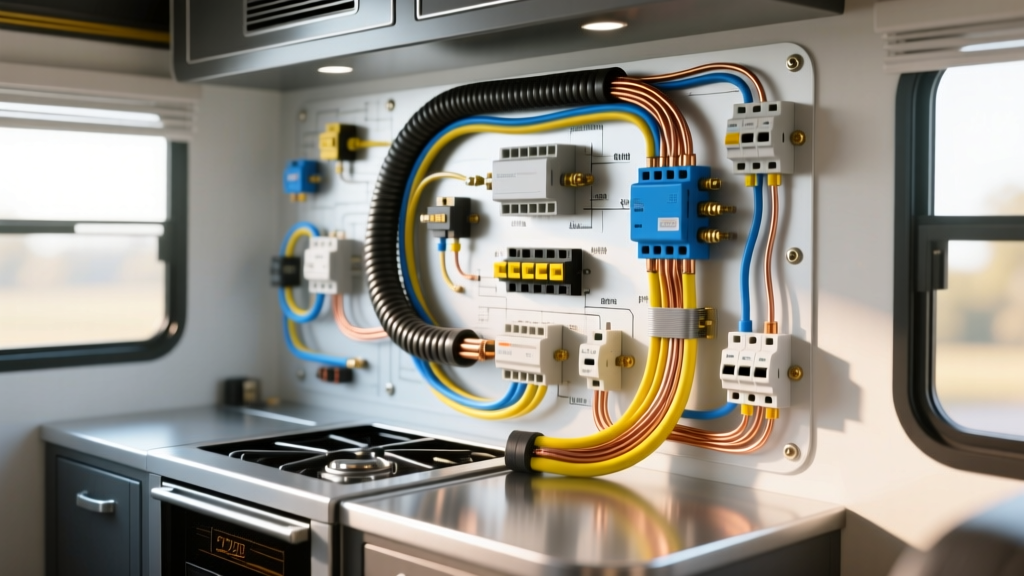
The Challenge: Powering a Residential Electric Range in an RV
Transitioning from propane to a full residential electric range or high-wattage induction cooktop is one of the most popular upgrade and modification projects for Class A motorhomes, skoolies, and luxury travel trailers. Eliminating propane reduces explosive gas risks and frees up undercarriage storage. However, integrating a 240V residential appliance into a mobile platform designed primarily for 120V AC and 12V DC systems requires meticulous electrical planning. When builders and DIYers ask what gauge wire for electric range installations in mobile environments, the answer depends entirely on the power source: 50-amp shore power integration or a split-phase inverter system.
What Gauge Wire for Electric Range: 240V Split-Phase Requirements
A standard residential electric range typically requires a 40-amp to 50-amp circuit at 240V to operate the oven and stovetop simultaneously. According to the National Electrical Code (NFPA 70), continuous loads (those expected to run for 3 hours or more, like baking) require conductors rated for 125% of the maximum load. Therefore, a 40-amp range requires wiring rated for at least 50 amps. In an RV or mobile chassis, vibration and heat demand the use of stranded copper wire with high-temperature insulation, such as THHN/THWN-2 or MTW (Machine Tool Wire).
Wire Gauge & Ampacity Chart for RV Electric Range Upgrades
| Circuit Rating | Wire Gauge (Stranded Copper) | Max Run Length (3% Voltage Drop) | Primary Application |
|---|---|---|---|
| 30 Amp | 10 AWG | 45 Feet | Compact 120V/240V Induction Cooktops |
| 40 Amp | 8 AWG | 55 Feet | Standard Slide-in Electric Ranges |
| 50 Amp | 6 AWG | 70 Feet | Full-Size Range / Double Oven Combos |
Note: For runs exceeding 70 feet from the main distribution panel to the galley, you must step up one gauge size (e.g., use 4 AWG for a 50-amp circuit) to mitigate voltage drop, which can damage sensitive range control boards.
Step-by-Step: Wiring the 50-Amp Shore Power Inlet
If your modification project involves running the electric range exclusively while connected to 50-amp campground shore power, you will be tying into the RV's main 50-amp distribution panel. The standard connector for this is the NEMA 14-50R receptacle, which provides two 120V legs (L1 and L2), a neutral, and a ground, yielding 240V across the two hot legs.
Pinout and Color Codes for NEMA 14-50R Integration
When wiring the branch circuit from the RV's main breaker panel to the range's junction box, strict adherence to color codes is critical for safety and RVIA (Recreation Vehicle Industry Association) compliance:
- Black (Line 1): 120V Hot Leg 1 (Connects to one pole of the 50A double-pole breaker).
- Red (Line 2): 120V Hot Leg 2 (Connects to the second pole of the 50A double-pole breaker).
- White (Neutral): Current-carrying conductor for 120V accessories (e.g., oven light, clock). Must be the same gauge as the hot wires (6 AWG or 8 AWG).
- Green or Bare (Ground): Equipment grounding conductor. Bonds the range chassis to the RV's main grounding bus bar.
Inverter Integration: Split-Phase 240V Systems
For off-grid skoolies and expedition vehicles, running an electric range requires a split-phase 240V inverter system (such as a Victron Quattro or dual stacked Magnum MS4024U inverters). This is where many DIYers make critical errors. While the AC side of the range requires 6 AWG or 8 AWG wire, the DC side of the inverter requires massive conductors to handle the low-voltage, high-amperage draw.
A 3,000W induction cooktop drawing from a 24V battery bank will pull roughly 125 Amps DC. If you are using a 12V system, that same cooktop pulls over 250 Amps. According to the Victron Energy Wiring Unlimited guide, the DC battery cables feeding the inverter must be sized to handle the peak surge current with minimal voltage drop.
DC Side Wire Sizing for Range Inverters
| Inverter Output | Battery Bank Voltage | Required DC Cable Gauge | Overcurrent Protection |
|---|---|---|---|
| 3000W (Induction Top) | 24V DC | 2/0 AWG | 250A ANL Fuse |
| 3000W (Induction Top) | 12V DC | 4/0 AWG | 400A Class T Fuse |
| 5000W (Full Range) | 48V DC | 2/0 AWG | 200A Class T Fuse |
Torque Specifications and Termination Best Practices
In mobile environments, vibration is the enemy of electrical connections. A loose wire on a 50-amp range circuit will create high resistance, leading to arcing, melted insulation, and potentially a chassis fire. When terminating 6 AWG or 8 AWG stranded wire into the range's terminal block or the RV's breaker panel, you must use closed-end ring terminals or heavy-duty ferrules.
- 6 AWG Terminals: Torque to 45 in-lbs (approx. 5.1 Nm).
- 8 AWG Terminals: Torque to 35 in-lbs (approx. 3.9 Nm).
- 10 AWG Terminals: Torque to 25 in-lbs (approx. 2.8 Nm).
Always use a calibrated torque screwdriver. Furthermore, apply an anti-oxidant compound (like Noalox) to aluminum-to-copper connections if your RV's distribution panel utilizes aluminum bus bars.
Real-World Troubleshooting & Failure Modes
When upgrading an RV to accommodate an electric range, technicians frequently encounter specific failure modes. Use this decision tree to diagnose issues:
Symptom: Inverter Shuts Down Under Range Load
- Cause 1: DC Voltage Drop. The battery cables are too long or undersized. Fix: Upgrade DC cables to 4/0 AWG and shorten the run between the battery bank and inverter.
- Cause 2: Low Battery Capacity. A single range burner can pull 1500W+ continuously. Fix: Ensure the Lithium battery bank has a continuous BMS discharge rating of at least 200A.
Symptom: Range Control Board Resets Randomly
- Cause 1: Unbalanced Split-Phase Loads. If the RV's 120V appliances are heavily loading L1 while L2 is empty, the neutral wire carries the imbalance, causing voltage fluctuations on the 240V legs. Fix: Balance the 120V branch circuits across both legs of the main panel.
- Cause 2: Loose Neutral Connection. Fix: Inspect the neutral bus bar and the range's terminal block. Re-crimp and torque the white neutral wire to spec.
Symptom: Shore Power Inlet Melting
- Cause: Running the electric range simultaneously with two roof A/C units on a 50-amp shore pedestal. The total draw exceeds the 50A main breaker rating, causing heat buildup at the NEMA 14-50P plug pins. Fix: Install an Energy Management System (EMS) with automatic load shedding to cycle the A/C compressors when the electric range is active.
Ultimately, determining what gauge wire for electric range projects in mobile platforms requires looking beyond the appliance sticker. By properly sizing both the 240V AC branch circuits and the massive DC inverter feeds, you can safely enjoy residential-style cooking anywhere the road takes you.