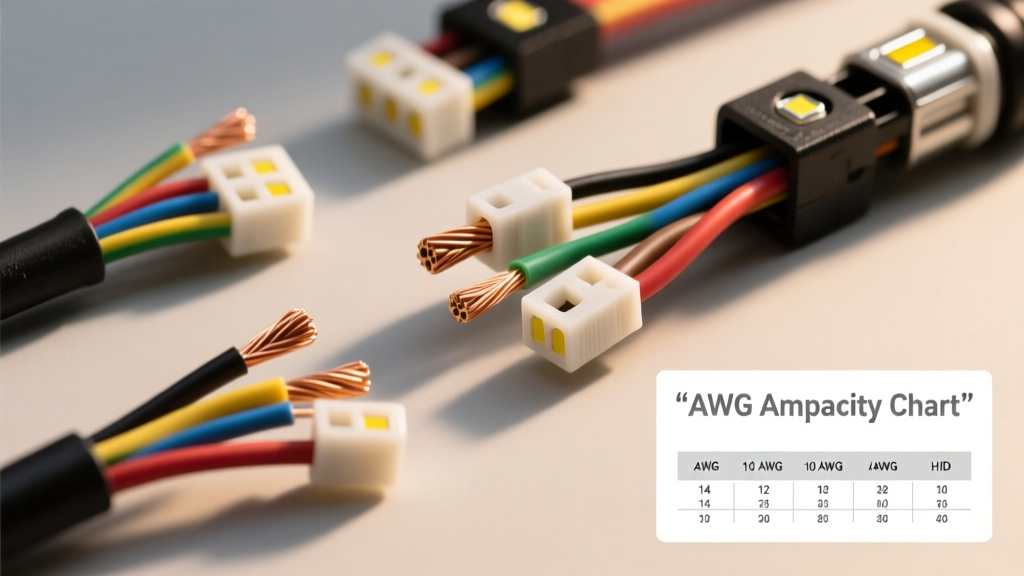
Determining What Gauge Wire for Lights is Critical for Automotive Systems
When upgrading or repairing automotive lighting, the most common question among off-road builders, restomod fabricators, and daily drivers is: what gauge wire for lights is required to prevent voltage drop, dimming, and electrical fires? The answer depends entirely on three variables: the total amperage draw of the lighting circuit, the total length of the wire run (positive and ground paths combined), and the ambient temperature rating of the wire jacket. Using undersized wire for high-draw halogen headlights or long-run LED light bars results in severe voltage drop, which not only reduces lumen output but also generates excess heat that can melt standard PVC insulation and trigger a short circuit.
Automotive electrical systems operate nominally at 13.8V to 14.4V when the alternator is charging. Unlike household wiring, which relies on the National Electrical Code (NEC), automotive wiring must adhere to SAE J1128 Low Tension Primary Cable Standards. This standard dictates thinner insulation with higher thermal resistance, meaning automotive wire can handle slightly different current loads than standard THHN copper wire used in residential applications.
Automotive Lighting Current Draw: Halogen vs. LED vs. HID
Before selecting an AWG (American Wire Gauge) size, you must calculate the total amperage of the circuit. Amperage is calculated using Ohm's Law: Amps = Watts / Volts. Assuming a standard charging system voltage of 13.8V, here is the typical current draw for common automotive lighting configurations:
- H4 Halogen Headlight (Low/High): 55W / 65W = 4.0A / 4.7A per bulb (8.0A to 9.4A total for both).
- LED Light Bar (30-inch, dual-row): 180W = 13.0A total.
- HID Headlight Kit (35W Ballast): 35W = 2.5A per bulb (5.0A total), but note that HID ballasts can draw up to 15A peak during the initial ignition strike phase.
- Standard 1157 LED Tail/Brake Light: 3W = 0.2A per bulb.
While LED technology is highly efficient, high-output off-road LED pods and light bars can easily pull 20A to 40A, requiring significantly thicker primary wire and heavy-duty relays.
What Gauge Wire for Lights: SAE AWG Specification Chart
The following chart outlines the maximum ampacity for standard cross-linked automotive wire (GXL/TXL) based on SAE J1128 guidelines. "Chassis Wiring" refers to short runs inside the engine bay or cabin (under 10 feet), while "Power Transmission" refers to longer runs from the battery to the rear of the vehicle or to high-draw accessories.
| AWG Size | Strand Count | Max Amps (Chassis <10ft) | Max Amps (Long Run >10ft) | Resistance per 1000ft (Ohms) | Typical Lighting Application |
|---|---|---|---|---|---|
| 18 AWG | 16 | 16A | 6A | 6.39 | Interior dome lights, dash indicators, relay trigger circuits (Pins 85/86) |
| 16 AWG | 19 | 22A | 8A | 4.02 | LED tail lights, license plate lamps, low-draw auxiliary lamps |
| 14 AWG | 19 | 32A | 12A | 2.52 | Standard LED light bars (up to 120W), halogen headlight pigtails |
| 12 AWG | 19 | 41A | 16A | 1.59 | High-draw 30-inch LED light bars, HID headlight main power feeds |
| 10 AWG | 19 | 55A | 24A | 1.00 | 50-inch dual-row LED light bars, main relay battery feed (Pin 30) |
Voltage Drop: The Hidden Enemy of Automotive Lighting
Answering "what gauge wire for lights" is incomplete without factoring in voltage drop. Voltage drop occurs because wire has inherent resistance. If the voltage at the headlight bulb drops below 12.0V, halogen bulbs will emit a yellow, dim light, and LED drivers may flicker or shut down entirely due to low-voltage protection circuits.
The formula for voltage drop in a DC circuit is: VD = (2 x L x I x R) / 1000
Where L is the one-way length in feet, I is current in amps, and R is the wire resistance per 1000ft.
Voltage Drop Reference Table (13.8V System, 20-Foot Total Run)
| Wire Gauge | Load (Amps) | Voltage Drop (V) | Voltage at Load | Acceptable? |
|---|---|---|---|---|
| 18 AWG | 5A | 0.64V | 13.16V | Yes (Under 3% drop) |
| 18 AWG | 10A | 1.28V | 12.52V | Borderline (Approaching 10% drop limit) |
| 14 AWG | 10A | 0.50V | 13.30V | Yes (Excellent) |
| 14 AWG | 15A | 0.75V | 13.05V | Yes (Acceptable) |
| 12 AWG | 20A | 0.63V | 13.17V | Yes (Excellent for light bars) |
According to Painless Performance Wiring Technical Guides, automotive circuits should be designed to keep voltage drop below 3% (approx. 0.41V) for sensitive electronics and lighting, and absolutely no higher than 5% for general accessories.
Implementing Bosch ISO 7588 Relays for Lighting Circuits
You should never route high-amperage headlight or light bar power directly through the steering column switch or OEM dashboard switch. Doing so will melt the switch contacts and cause a fire. Instead, use a standard 30A or 40A Bosch-style ISO relay. Here is the correct pinout and wire gauge specification for a standard automotive lighting relay harness:
- Pin 30 (Common Input): 10 AWG or 12 AWG wire directly from the battery positive terminal, protected by an inline MAXI or AGU fuse rated at 125% of the total load.
- Pin 87 (Normally Open Output): 12 AWG or 14 AWG wire running to the positive terminal of the lights.
- Pin 85 (Coil Ground): 18 AWG wire grounded to a clean, bare metal chassis point using a ring terminal and star washer.
- Pin 86 (Coil Trigger): 18 AWG wire connected to the OEM headlight switch, upfitter switch, or ignition-switched 12V+ source.
SAE Wire Jacket Types and Connector Selection
When purchasing wire for automotive lights, avoid standard PVC "primary wire" found in big-box hardware stores. PVC insulation becomes brittle in sub-zero temperatures and melts at relatively low engine bay temperatures. Instead, specify Cross-Linked Polyethylene (XLPE) jacketed wire, which meets SAE J1128 specifications:
- GXL (General Cross-Linked): Standard wall thickness, rated to 125°C. Ideal for engine bay headlight routing.
- TXL (Thin Cross-Linked): Thin wall, rated to 125°C. Best for routing through tight firewall grommets and interior dash harnesses.
- SXL (Special Cross-Linked): Thick wall, rated to 125°C. Used for high-vibration, high-heat areas near exhaust manifolds.
For connectors, avoid cheap spade connectors that corrode quickly. For under-hood halogen headlights, use Aptiv Weather-Pack connectors, which feature silicone seals that withstand moisture and temperatures from -40°C to 125°C. For off-road LED light bars exposed to extreme vibration and water submersion, Deutsch DT series connectors are the industry standard, utilizing solid copper contacts and secondary silicone wedge locks to prevent pin back-out.
Troubleshooting Common Automotive Lighting Wiring Failures
If you have selected the correct gauge wire but are still experiencing issues, troubleshoot using this decision tree:
- Symptom: Lights flicker at high RPM.
Cause: Poor chassis ground or voltage regulator failure.
Fix: Check the ground wire (Pin 85 or direct light ground). Ensure it is secured to bare metal, not painted frame rail. Add a dedicated 12 AWG ground strap from the engine block to the chassis. - Symptom: Halogen lights are dim yellow, but LED pods are bright.
Cause: High resistance in the positive feed or OEM headlight switch.
Fix: Measure voltage at the headlight pigtail with the engine running. If it reads below 12.5V, install a 30A relay harness directly from the battery to bypass the OEM wiring. - Symptom: LED light bar turns off after 5 minutes of use.
Cause: Undersized wire causing voltage drop, triggering the LED driver's thermal or low-voltage shutdown.
Fix: Upgrade the main feed from 14 AWG to 10 AWG and verify the inline fuse is not overheating.