Understanding Std Wire Gauge in Automotive Systems
When beginners dive into automotive electrical work, the term std wire gauge (standard wire gauge) is frequently thrown around in forums and repair manuals. However, this term can cause immense confusion. In North American automotive applications, "std wire gauge" almost exclusively refers to the American Wire Gauge (AWG) system. Conversely, the Imperial Standard Wire Gauge (SWG) is an obsolete standard primarily found in classic British vehicles with Lucas electrical systems. For 99% of modern vehicle builds, restorations, and repairs, you will be working exclusively with AWG.
The most critical fundamental to grasp is the inverse relationship of the AWG system: the higher the gauge number, the thinner the wire. A 22-gauge wire is incredibly thin and used for low-current sensor signals, while a 4-gauge wire is thick and used for high-current starter motors. Choosing the wrong std wire gauge doesn't just lead to blown fuses; it creates severe fire hazards, voltage drops that confuse engine control units (ECUs), and melted insulation.
The Hardware Store Trap: PVC vs. Automotive Cross-Linked Wire
Before calculating your std wire gauge, you must understand automotive wire insulation. Beginners often make the costly mistake of buying standard PVC-insulated wire from a local hardware store. Hardware store wire is rated for household 120V/240V AC environments, not the harsh, high-heat, chemical-rich environment of a vehicle engine bay.
According to SAE International standard J1128, automotive primary wire must meet strict resistance criteria for heat, abrasion, and chemicals. You should only use cross-linked polyethylene (XLPE) insulated wires for automotive projects. The three main types you will encounter are:
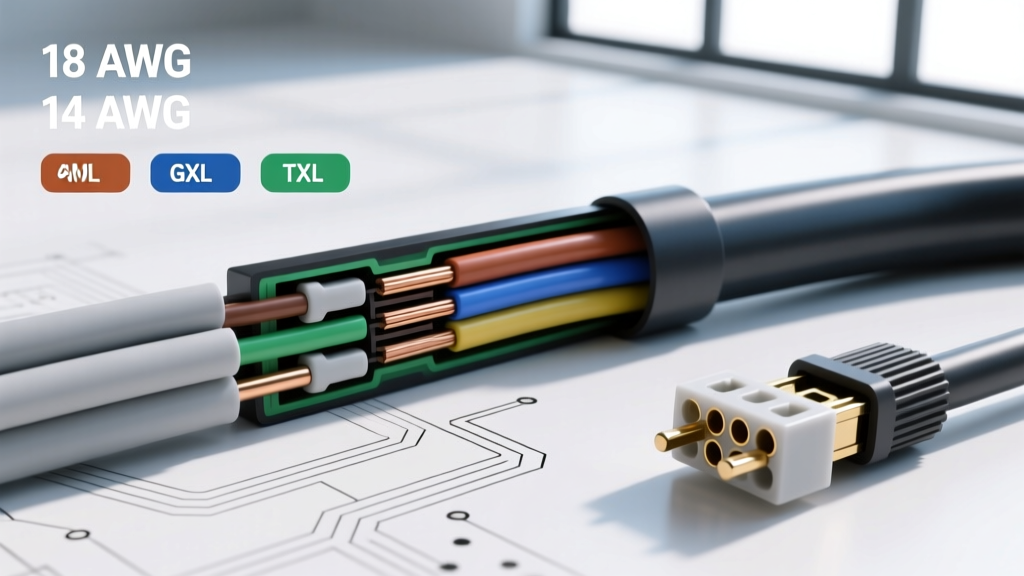
- TXL (Thin-wall cross-linked): The modern standard. Offers excellent heat resistance up to 125°C (257°F) with a thin profile, making it ideal for tight harness wraps and modern ECU connectors.
- GXL (General-purpose cross-linked): Slightly thicker insulation than TXL, rated for 125°C. Excellent for general chassis wiring and engine bay routing.
- SXL (Specialty cross-linked): The thickest insulation, rated up to 150°C (302°F). Used in heavy-duty commercial trucks or extreme-heat areas near exhaust manifolds.
Using standard PVC wire near an exhaust header will result in the insulation melting and shorting to the chassis, potentially destroying an ECU or starting an electrical fire.
Standard Automotive Wire Gauge Ampacity Chart
The following chart outlines the standard AWG sizes used in 12V to 14.4V automotive systems. Ampacity ratings vary based on whether the wire is routed through the cool cabin (chassis) or the hot engine bay. Always size your wire based on the engine bay rating if the wire touches the firewall or engine block.
| AWG Size | Strand Count | Nominal OD (Inches) | Max Amps (Chassis/Cabin) | Max Amps (Engine Bay) | Common Automotive Application |
|---|---|---|---|---|---|
| 22 | 7 | 0.029 | 3A | 2A | ECU Sensors (MAP, TPS, IAT) |
| 20 | 19 | 0.037 | 5A | 4A | Low-current signals, CAN bus lines |
| 18 | 16 | 0.040 | 6A | 5A | Interior lighting, radio memory |
| 16 | 26 | 0.051 | 10A | 8A | Instrument clusters, window switches |
| 14 | 41 | 0.064 | 15A | 12A | Tail lights, horn, ECU main power |
| 12 | 65 | 0.081 | 20A | 15A | Headlights, fuel pump, power seats |
| 10 | 105 | 0.102 | 30A | 25A | Ignition coils, high-draw accessories |
| 8 | 168 | 0.128 | 40A | 35A | Alternator output, main relay feeds |
| 4 | 133 | 0.204 | 60A+ | 60A+ | Battery to starter, chassis grounds |
Matching Std Wire Gauge to Common Vehicle Circuits
To build a reliable harness, you must match the std wire gauge to the specific electrical load and circuit type. Here is a breakdown of how professional automotive electricians configure standard circuits.
1. ECU and Sensor Circuits (20 to 22 AWG)
Modern engine management systems rely on precise 5-volt reference signals. Wires for sensors like the Throttle Position Sensor (TPS), Manifold Absolute Pressure (MAP), and Intake Air Temperature (IAT) carry less than 1 amp of current. Because the current is so low, 20 AWG or 22 AWG TXL wire is the standard.
Real-World Example: On a GM LS engine, the MAP sensor typically uses a 3-pin Delphi Metri-Pack 150 connector. The wiring standard dictates a Gray wire (5V Reference), a Black wire (Sensor Ground), and a Light Green wire (Signal Return). Using wire thicker than 20 AWG here makes it impossible to properly seat the pins into the tiny Metri-Pack 150 cavities without damaging the terminal.
2. Lighting and Accessory Circuits (12 to 14 AWG)
Lighting circuits draw moderate current but are highly susceptible to voltage drop. A standard H11 halogen headlight bulb draws about 55 watts, which equates to roughly 4.5 amps at 12 volts. While a 16 AWG wire can technically handle 8 amps in an engine bay, the length of the wire from the front-mounted fuse box to the headlight housing creates resistance.
Pro-Tip: Always use 12 AWG GXL wire for headlight circuits. This ensures the bulb receives a full 13.5+ volts when the alternator is charging, maximizing lumen output and preventing the connector from melting due to resistance-induced heat. Use sealed Weather-Pack or Metri-Pack 280 connectors to prevent moisture intrusion, which causes corrosion and increases resistance over time.
3. High-Current Power Circuits (8 to 4 AWG)
The starter motor and alternator require massive bursts of current. A standard V8 starter can pull 150 to 250 amps under load. For these circuits, 4 AWG or 2 AWG battery cable is mandatory. When routing these heavy-gauge cables, always use heavy-duty ring terminals crimped with a hydraulic or heavy mechanical crimper, and seal the connections with adhesive-lined marine heat shrink to prevent battery acid corrosion.
The Silent Killer: Voltage Drop and Wire Length
The biggest mistake beginners make with std wire gauge is ignoring wire length. Ampacity charts assume short runs. However, a 12 AWG wire can safely carry 15 amps for a 5-foot run, but if you run that same 12 AWG wire 25 feet from the battery to a rear-mounted fuel pump in a trunk, the resistance of the copper will cause a severe voltage drop.
In a 12V automotive system, a voltage drop of more than 2% (0.24 volts) on a power circuit is considered unacceptable. If your fuel pump receives only 10.5 volts instead of 13.8 volts, it will spin slower, deliver inadequate fuel pressure, and cause the engine to run lean, potentially resulting in catastrophic engine damage.
The Fix: When running wire to the rear of a long-wheelbase vehicle or truck, always step up one or two gauge sizes. If the chart calls for 12 AWG, use 10 AWG or even 8 AWG to negate the resistance of the long run. Always measure voltage at the component with a digital multimeter while the circuit is under load to verify your wire gauge choice is adequate.
Essential Connectors for Standard Gauges
Your std wire gauge is only as good as the termination. Soldering is generally frowned upon in modern automotive harness building because solder wicks into the wire strands, creating a rigid point that easily snaps under engine vibration. Instead, use high-quality open-barrel crimps and OEM-style connectors:
- Delphi Metri-Pack 150: Designed for 20-22 AWG wires. Used for ECU sensors and low-draw signals.
- Delphi Metri-Pack 280: Designed for 14-18 AWG wires. Used for injectors, ignition coils, and interior switches.
- Weather-Pack: Older but robust, accommodating 12-16 AWG wires. Excellent for external lighting and winch controls.
- Deutsch DT Series: The gold standard for harsh environments. Accepts 14-20 AWG wires and uses silicone seals to block water and oil completely.
Summary: Best Practices for Beginners
Mastering the std wire gauge system is the foundation of reliable automotive electrical work. Always prioritize SAE J1128 rated cross-linked wire (TXL/GXL) over cheap PVC alternatives. Respect the inverse nature of the AWG system, account for engine bay heat when calculating ampacity, and always step up your wire gauge for long harness runs to prevent voltage drop. By combining the correct wire size with proper open-barrel crimping and sealed connectors, you will build a harness that outlasts the vehicle itself.