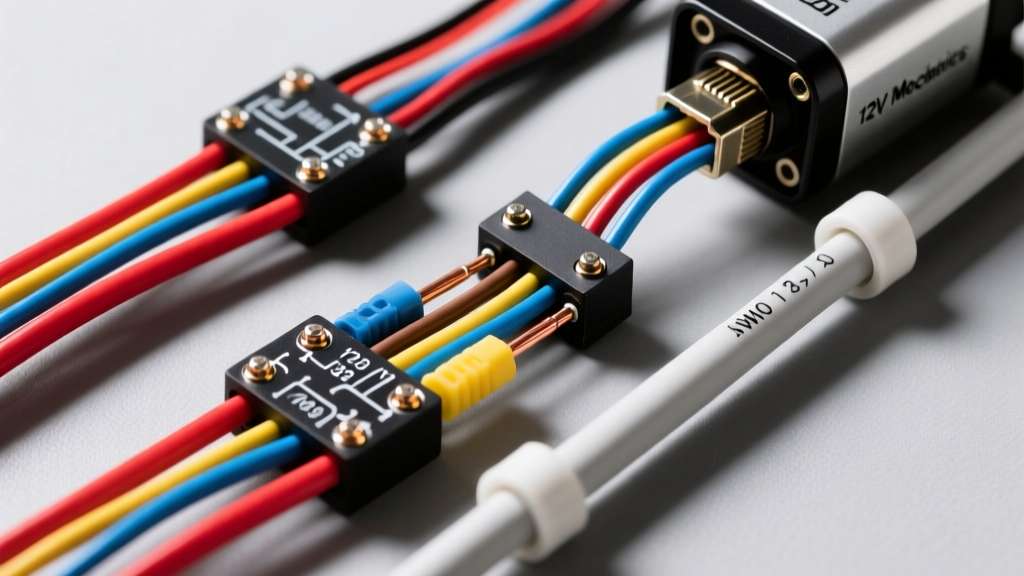
The Paradigm Shift: From Residential AC to Automotive 12V DC
For professionals who have built a business as Nest outdoor camera installers, the transition into the automotive, overland, and recreational vehicle (RV) market presents a highly lucrative opportunity. However, the fundamental physics and electrical environments of a residential exterior wall versus a vehicle chassis are vastly different. When mounting an IP camera on a motorhome, expedition trailer, or custom overland rig, you are no longer dealing with a stable 120V AC mains supply or a standard 802.3af Power over Ethernet (PoE) switch plugged into a wall. You are entering a volatile 12V DC environment characterized by voltage spikes, alternator noise, and severe vibration.
This beginner-friendly fundamentals guide bridges the gap between home security installation and automotive electrical systems. We will cover how to properly integrate exterior IP cameras into a vehicle's 12V house battery system, select the correct wire gauges, manage electromagnetic interference (EMI), and utilize vibration-resistant connectors that meet automotive standards.
Voltage Drop and AWG Selection in Mobile Environments
In residential installations, voltage drop over a 50-foot Cat5e run is negligible when dealing with 48V PoE. In a 12V automotive system, voltage drop is the primary enemy. A standard IP camera and its associated 12V-to-48V PoE injector may draw 20 watts. At 12V, this equates to a continuous draw of roughly 1.67 amps. However, DC-DC step-up converters experience inrush currents that can momentarily spike 300% higher than the continuous draw.
If you use standard 18 AWG security wire for the 12V feed from the vehicle's auxiliary battery to the PoE injector, the resistance of the wire will cause the voltage at the injector to drop below 11V during startup. This triggers the injector's undervoltage lockout (UVLO), resulting in a boot-loop where the camera continuously restarts but never powers on.
Automotive Wire Sizing Chart for 12V Camera Feeds
| Wire Gauge (AWG) | Max Continuous Amps (Auto) | Recommended Max Run (12V Feed) | Application |
|---|---|---|---|
| 16 AWG | 10A | 8 Feet | Low-draw analog backup cameras |
| 14 AWG | 15A | 15 Feet | 12V-to-48V PoE Injectors, PTZ IP Cameras |
| 12 AWG | 20A | 25 Feet | Multiple camera POE switches, NVR units |
| 10 AWG | 30A | 40+ Feet | Main inverter feeds, heavy DC-DC chargers |
Note: Always use stranded copper wire with cross-linked polyethylene (XLPE) or GXL insulation for automotive applications. Standard THHN solid-core wire will fracture under vehicular vibration and thermal cycling.
Powering IP Cameras: DC-DC Conversion and PoE Injection
Because high-quality outdoor cameras (similar in form factor and function to the Nest outdoor line) utilize PoE for data and power, you must generate 48V DC from the vehicle's 12V system. This requires an isolated DC-DC step-up converter paired with a PoE injector.
Step-by-Step Power Integration
- Battery Connection: Connect the 12V input of the DC-DC converter directly to the vehicle's auxiliary 'house' battery bank. Never wire camera systems to the vehicle's starter battery or CAN-bus-controlled accessory circuits, as modern vehicle BCMs (Body Control Modules the camera and network switch.
Signal Interference: Alternator Whine and EMI Shielding
Residential installers rarely deal with electromagnetic interference (EMI) unless routing cables parallel to high-voltage AC lines. In a vehicle, the alternator generates massive amounts of AC ripple and high-frequency switching noise from ignition coils and LED drivers. If your IP camera or DC-DC converter shares a ground path with the vehicle's lighting system, you will introduce ground loops.
According to SAE J1113 standards for electromagnetic compatibility, automotive electronic components must be shielded against conducted and radiated emissions. To prevent data packet loss on your Cat5e/Cat6 runs and protect the camera's image sensor from banding:
- Star Grounding: Run a dedicated 14 AWG ground wire from the PoE injector directly to the battery negative terminal or a verified, bare-metal chassis ground point. Do not daisy-chain grounds.
- Shielded Ethernet (STP): Use Shielded Twisted Pair (STP) Cat6 cable with a grounded drain wire. Terminate the drain wire at the PoE injector's ground block, but leave it floating at the camera end to prevent creating a ground loop antenna.
- Ferrite Cores: Snap ferrite chokes onto the 12V DC input cables near the DC-DC converter to suppress high-frequency alternator whine.
Connector Standards: Ditching the RJ45
The standard RJ45 connector used in residential Nest and PoE installations is entirely unsuited for the exterior of a vehicle. Vibration will shatter the plastic retaining clips, and moisture ingress will corrode the copper pins within weeks, leading to PoE negotiation failures and short circuits.
For automotive and RV exterior camera deployments, you must transition to circular, environmentally sealed connectors.
Automotive Connector Pinout Reference
| Connector Type | IP Rating | Vibration Resistance | Best Use Case |
|---|---|---|---|
| RJ45 (Standard) | IP20 | Low | Interior NVR / Switch connections only |
| M12 X-Coded | IP67/IP69K | Extreme | Exterior IP Cameras, high-speed Gigabit data + PoE |
| 4-Pin Aviation (GX12) | IP65 | High | Analog Furrion/Voyager RV backup cameras |
| Deutsch DT Series | IP68 | Extreme | 12V DC power feeds to PoE injectors |
When adapting Cat6 to an M12 X-coded connector for an exterior camera, ensure you follow the TIA/EIA-568-B color code mapped to the M12 8-pin layout. Pin 1 (White/Orange) maps to M12 Pin 1, Pin 2 (Orange) maps to M12 Pin 2, and so forth. Always use a marine-grade adhesive-lined heat shrink over the cable gland to prevent capillary action from wicking moisture down the cable jacket and into the camera housing.
Chassis Penetration and Fire Safety
Drilling into a vehicle's body or an RV's fiberglass/metal bulkhead requires strict adherence to safety protocols. The NFPA 1192 Standard on Recreational Vehicles dictates that any wiring passing through a metal bulkhead must be protected by a non-combustible, abrasion-resistant grommet to prevent the chassis from slicing through the wire insulation, which could cause a catastrophic DC short circuit and fire.
After routing the STP Cat6 and 12V power lines through a rubber bulkhead grommet, seal both sides of the penetration with automotive-grade butyl rubber tape, followed by a bead of marine silicone. This prevents exhaust gases, carbon monoxide, and water from entering the vehicle's interior cabin.
Troubleshooting Decision Tree: Common Automotive IP Camera Failures
When an installation fails to boot, use this diagnostic sequence before replacing hardware:
- Symptom: Camera boots, but loses link when vehicle engine starts.
Cause: Alternator voltage spike exceeding the DC-DC converter's overvoltage protection (OVP), or severe EMI disrupting the Ethernet handshake.
Fix: Install a transient voltage suppression (TVS) diode on the 12V input and verify STP cable shielding is properly grounded. - Symptom: PoE injector clicks repeatedly; camera never powers on.
Cause: Voltage drop on the 12V input side causing UVLO during the camera's IR-cut filter mechanical switch (which draws peak current).
Fix: Upgrade the 12V feed wire from 16 AWG to 12 AWG and check all crimp terminals for high resistance. - Symptom: Camera works while driving, but dies when parked.
Cause: The 12V feed was mistakenly tapped into a CAN-bus-controlled ignition-switched circuit rather than the constant 12V house battery.
Fix: Reroute power to a dedicated auxiliary battery bank with a low-voltage disconnect (LVD) to prevent parasitic drain.
Summary for the Transitioning Installer
While the optical and networking principles remain identical to residential Nest outdoor camera setups, the physical layer of automotive and RV wiring demands a completely different approach. By prioritizing heavy-gauge stranded wiring, isolated DC-DC power conversion, vibration-proof M12 connectors, and strict adherence to SAE and NFPA standards, home security professionals can successfully pivot into the high-demand mobile surveillance market. For further reading on automotive electrical baselines, consult the IEEE 802.3af PoE specifications to understand how negotiation protocols react to non-standard DC power sources.