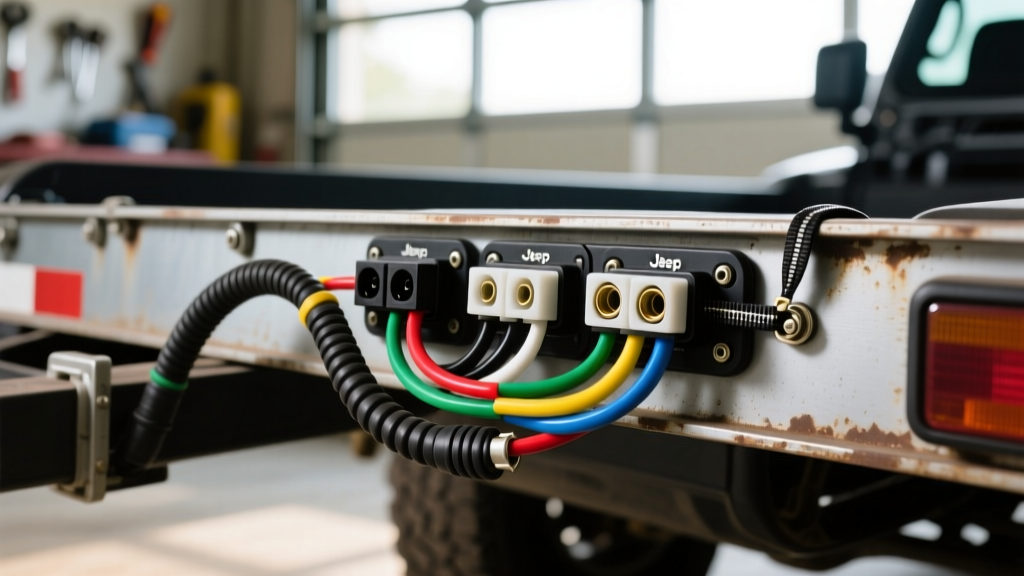
Understanding Your Wrangler's Electrical Architecture
Installing a Jeep Wrangler trailer wiring harness is a rite of passage for off-roaders and overlanders looking to tow teardrop campers, utility trailers, or motorcycle carriers. However, modern Wranglers are not simple point-to-point wired vehicles. They utilize complex Controller Area Network (CAN bus) systems and sensitive power distribution modules. For beginners, understanding this architecture is the difference between a seamless towing experience and a stranded vehicle with disabled tail lights.
Unlike older vehicles where you could simply splice into the tail light wires, modern Jeeps monitor electrical current draw. If the system detects an anomaly—such as a short circuit in a cheap trailer harness or an over-amped bulb—the vehicle's computer will actively shut down the circuit to protect the wiring. This guide breaks down the fundamentals of selecting, installing, and troubleshooting a trailer wiring harness specifically for Jeep Wrangler models, ensuring your setup is safe, legal, and reliable.
4-Way Flat vs. 7-Way RV Blade Pinouts
Before purchasing a harness, you must match the connector to your trailer's requirements. The two most common configurations for Wrangler owners are the 4-Way Flat and the 7-Way RV Blade.
Standard 4-Way Flat Configuration
The 4-pin connector is standard for lightweight utility trailers and small boat trailers that do not require electric brakes or auxiliary 12V power. According to etrailer's wiring standards, the pinout and wire color codes are universally standardized:
| Pin Function | Wire Color | Gauge (AWG) | Description |
|---|---|---|---|
| Ground | White | 16 or 14 | Completes the circuit; must be grounded to bare chassis metal. |
| Tail/Running Lights | Brown | 16 | Powers marker lights and tail lights when headlights are on. |
| Left Turn/Stop | Yellow | 16 | Combined brake and left turn signal circuit. |
| Right Turn/Stop | Green | 16 | Combined brake and right turn signal circuit. |
7-Way RV Blade Configuration
If you are towing a camper with electric brakes, you need a 7-way connector. This setup adheres to the SAE J560 Standard for heavy-duty and RV connectors, adding circuits for electric brakes, a 12V auxiliary power feed, and reverse lights.
| Pin Position (Clock) | Function | Wire Color | Gauge (AWG) |
|---|---|---|---|
| Center | Ground | White | 10 or 8 |
| 12 O'Clock | Tail/Running Lights | Brown | 14 |
| 3 O'Clock | Right Turn/Stop | Green | 14 |
| 5 O'Clock | Electric Brakes | Blue | 10 |
| 7 O'Clock | 12V Auxiliary Power | Black or Red | 10 |
| 9 O'Clock | Left Turn/Stop | Yellow | 14 |
| 11 O'Clock | Reverse Lights | Purple | 14 |
The JK vs. JL Wiring Divide: What Beginners Must Know
One of the most critical concepts for Wrangler owners is the generational divide in electrical systems. The installation method changes drastically depending on whether you drive a JK (2007-2018) or a JL (2018-Present).
JK Wrangler (2007-2018): The TIPM Warning
The JK Wrangler uses a Totally Integrated Power Module (TIPM). The TIPM acts as a smart fuse box, replacing traditional relays with solid-state switches. If you splice a standard, unpowered trailer harness directly into a JK's tail light wires, the trailer's power draw will route through the TIPM. If a trailer wire shorts out against the hitch, the TIPM will detect the over-current and permanently disable the tail light circuit. Resetting a locked-out TIPM often requires a dealer-level OBD2 scan tool or replacing the entire $1,000+ module.
The Solution: JK owners without the factory tow package must use a powered taillight converter (such as the Curt 56201 or Hopkins 46365). This device uses the Jeep's tail light wires only as low-amperage signals. The actual power for the trailer lights is drawn directly from the Wrangler's battery via an inline 15-amp fused 12 AWG wire, completely bypassing and protecting the sensitive TIPM.
JL Wrangler (2018-Present): Dedicated Trailer Module
Stellantis engineers learned from the JK's TIPM vulnerabilities. The JL Wrangler features a dedicated Trailer Tow Module located behind the rear driver-side interior trim panel. If your JL has the factory tow package, installing a harness is a true plug-and-play experience. You simply unplug a dummy cap from the factory module and plug in the Mopar or aftermarket harness. For JLs without the factory tow package, aftermarket kits now interface with the CAN bus via the OBD2 port or dedicated module taps, safely isolating the trailer circuit just like the factory system.
Step-by-Step Harness Routing for Off-Road Durability
Wranglers are subjected to water fording, mud, and extreme suspension articulation. Routing your harness correctly is vital to prevent the wires from tearing when the rear Dana 44 axle drops.
- Remove the Rear Bumper or Access Panel: On most JKs and JLs, you will need to remove the passenger side tail light (using a T20 Torx bit on JLs, or an 8mm socket on older models) to access the rear corner cavity.
- Follow the Factory Harness Path: Always route the new harness alongside the factory ABS and parking brake cables. These factory lines already account for full rear suspension droop and compression.
- Use Split Loom and Adhesive Zip Ties: Wrap the entire length of the 16 AWG lighting wires in 1/4-inch corrugated split loom tubing. Secure the loom to the frame's C-channel using adhesive-backed zip tie mounts. Never drill into the frame to route wires, as this compromises structural integrity and introduces rust points.
- Protect the 7-Way Connector: If installing a 7-way bracket on the rear hitch, apply a thick layer of dielectric grease to the pins. Wrap the first 12 inches of the harness behind the bracket in friction tape (Tesa tape) to prevent the harness from vibrating against the powder-coated hitch and wearing through the insulation.
Wire Gauge and Amperage Specifications
Using the correct American Wire Gauge (AWG) is non-negotiable to prevent voltage drop and fire hazards. Refer to the Mopar Towing Guidelines for factory-approved electrical limits.
| Circuit Type | Recommended AWG | Max Amperage | Breaker/Fuse Requirement |
|---|---|---|---|
| Standard 4-Way Lighting | 16 AWG | 7.5 Amps per circuit | 10A Inline ATC Fuse |
| Powered Converter Feed | 12 AWG | 15 Amps continuous | 15A Inline ATC Fuse |
| 7-Way 12V Auxiliary | 10 AWG | 30 Amps continuous | 30A Auto-Reset Circuit Breaker |
| Electric Brake Controller | 10 AWG (Blue) | 30 Amps peak | 30A Auto-Reset Circuit Breaker |
Troubleshooting Common Wrangler Trailer Light Failures
Even with a perfect installation, environmental factors can cause issues. Use this diagnostic tree to solve common problems:
Symptom: Trailer Lights Work, but Jeep Dashboard Throws a 'Trailer Disconnected' Error
Cause: LED trailer lights draw significantly less amperage than incandescent bulbs. The Wrangler's CAN bus system expects a specific resistance. If the draw is too low, the computer assumes the trailer is unplugged.
Fix: Install inline load resistors (typically 6-ohm, 50-watt) on the yellow and green turn signal wires, or purchase a CAN bus-compatible LED trailer harness that features built-in pulse-width modulation (PWM) decoders.
Symptom: Hyper-Flashing Turn Signals When Trailer is Connected
Cause: Similar to the error above, the low resistance of LED trailer lights tricks the Jeep's flasher relay into thinking a bulb is blown.
Fix: Ensure your powered converter module has an integrated LED compatibility chip. If using a basic module, add load resistors to the turn signal circuits.
Symptom: All Trailer Lights Flicker Over Bumps
Cause: A 'floating ground' or poor chassis ground. The white ground wire is likely attached to painted metal, or the ring terminal is loose.
Fix: Remove the ground ring terminal. Sand the chassis contact point down to bare, shiny metal. Reattach the terminal using a stainless steel star washer to bite through any surface oxidation, and coat the connection in liquid electrical tape to prevent moisture ingress.
Symptom: Running Lights Blow the Inline Fuse Immediately
Cause: A short in the brown wire, often caused by the harness rubbing against the sharp edge of the trailer tongue or the Wrangler's rear diff cover.
Fix: Inspect the brown wire from the connector back to the 4-way plug. Look for pinched insulation. Repair using marine-grade heat-shrink butt connectors, never standard twist-on wire nuts or electrical tape, which will unravel in wet off-road conditions.