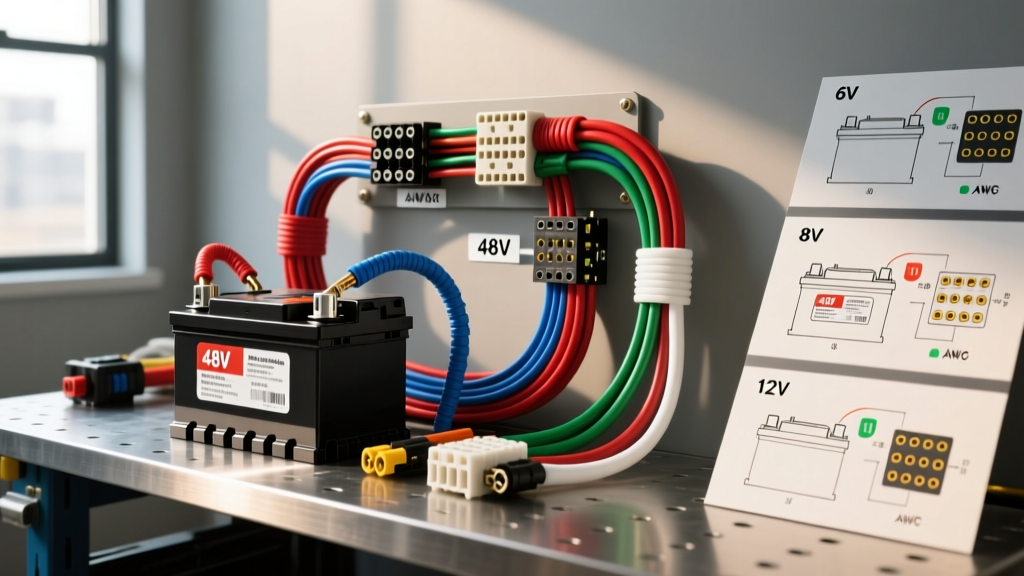
Introduction to 48V Electric Drivetrains and Battery Selection
Upgrading, rebuilding, or maintaining an electric golf cart requires a precise understanding of series circuits, voltage drop, and continuous amperage loads. Whether you are working on a Club Car Precedent, an EZ-GO RXV, or a Yamaha Drive, the electrical architecture relies on a robust 48-volt DC supply. When consulting a standard 48v 48 volt golf cart battery wiring diagram, the most critical factor is matching the physical battery configuration to the motor controller's amperage requirements. Selecting the wrong battery arrangement or utilizing undersized interconnect cables will result in severe voltage sag, premature battery sulfation, and controller fault codes.
This guide serves as a comprehensive product comparison and selection manual for 48V battery banks. We will break down the three primary configurations (6V, 8V, and 12V arrays), provide exact series routing matrices, and detail the SAE-compliant hardware specifications required for a safe, high-performance installation.
Comparing 48V Battery Bank Configurations
Before routing a single cable, you must select the battery bank topology that fits your physical tray constraints, budget, and depth-of-discharge (DoD) requirements. A 48V system is achieved by wiring batteries in series, which multiplies the voltage while maintaining the amp-hour (Ah) capacity of a single unit.
8 x 6V Deep Cycle (The Fleet Standard)
- Configuration: Eight 6V batteries wired in series (e.g., Trojan T-105 or Crown CR-235).
- Specifications: 48V nominal, ~225Ah at the 20-hour rate.
- Pros: Thickest lead plates available in standard golf cart footprints. Unmatched cycle life and deep-discharge recovery. Ideal for heavy fleet use and hilly terrain.
- Cons: Extremely heavy (over 500 lbs total). Requires watering 24 individual cells. Takes up the maximum amount of physical space in the battery tray.
6 x 8V Deep Cycle (The Modern Compromise)
- Configuration: Six 8V batteries wired in series (e.g., US Battery 8VGC2 or Trojan T-875).
- Specifications: 48V nominal, ~170Ah at the 20-hour rate.
- Pros: Lighter than the 6V setup (saves roughly 80 lbs). Faster recharge times due to lower overall Ah capacity. Only 12 cells to water and maintain.
- Cons: Reduced total range compared to 6V setups. Slightly thinner internal plates mean a shorter overall lifespan if regularly discharged below 50%.
4 x 12V AGM or Lithium (The Space Saver)
- Configuration: Four 12V deep cycle batteries (e.g., Relion Lithium GC12V or VMAXTANKS AGM).
- Specifications: 48V nominal, varies widely (100Ah to 150Ah).
- Pros: Simplest wiring diagram (only 3 interconnects). Zero maintenance if using AGM or Lithium. Lithium variants offer a 10-year lifespan and 80% DoD capability.
- Cons: Standard 12V lead-acid deep cycle batteries suffer from premature cell death in series strings due to minor capacitance imbalances. Lithium options require a compatible BMS (Battery Management System) and specific charger profiles.
48v 48 Volt Golf Cart Battery Wiring Diagram: Series Routing
Regardless of whether you choose 6V, 8V, or 12V units, the series wiring principle remains identical. The positive terminal of the first battery connects to the main positive load, while the negative terminal of the last battery connects to the main negative return. All intermediate connections alternate positive-to-negative.
Below is the universal interconnect routing matrix for a standard 8-battery (6V) setup. This sequence ensures even current distribution across the physical tray.
| Interconnect Cable | From Terminal | To Terminal | Cable Color / AWG |
|---|---|---|---|
| Main Positive Out | Battery 1 (Positive) | Controller / Solenoid | Red / 2/0 AWG |
| Link 1 | Battery 1 (Negative) | Battery 2 (Positive) | Black / 2 AWG |
| Link 2 | Battery 2 (Negative) | Battery 3 (Positive) | Black / 2 AWG |
| Link 3 | Battery 3 (Negative) | Battery 4 (Positive) | Black / 2 AWG |
| Link 4 | Battery 4 (Negative) | Battery 5 (Positive) | Black / 2 AWG |
| Link 5 | Battery 5 (Negative) | Battery 6 (Positive) | Black / 2 AWG |
| Link 6 | Battery 6 (Negative) | Battery 7 (Positive) | Black / 2 AWG |
| Link 7 | Battery 7 (Negative) | Battery 8 (Positive) | Black / 2 AWG |
| Main Negative Out | Battery 8 (Negative) | Controller / OBC Shunt | Black / 2/0 AWG |
Vehicle-Specific Wiring: OBC Shunts and Motor Controllers
While the battery-to-battery series links are universal, the main negative return wire requires vehicle-specific attention. Miswiring the main negative will bypass critical charging safeties.
Club Car Precedent (Onboard Computer Routing)
In a Club Car Precedent, the main negative cable from the final battery must not go directly to the motor controller. It must route through the Onboard Computer (OBC) current shunt. The OBC monitors the amp-hours drawn from the pack and uses this data to dictate the charging cycle. Bypassing the OBC shunt will result in the charger never shutting off, leading to thermal runaway and boiled batteries.
EZ-GO TXT and RXV (Direct Controller Routing)
Traditional EZ-GO TXT models with standard solid-state controllers route the main negative directly to the controller's B- terminal. However, the newer RXV platform, especially when equipped with the ELiTE lithium system, utilizes a proprietary BMS communication harness. When retrofitting an RXV with aftermarket lead-acid batteries, you must install a heavy-duty 500A shunt and ensure the main negative passes through the shunt before terminating at the controller ground bus.
Cable Selection: AWG Sizing, Lugs, and Torque Specifications
Using automotive battery cables for golf carts is a common and dangerous mistake. Golf carts draw continuous high amperage (often 150A to 300A under load), whereas car starter cables only handle high amperage for a few seconds. You must use SAE J1128 compliant, fine-strand, pure copper welding cable or specialized EV battery cable.
| Cable Application | Recommended AWG | Strand Count (Min) | Lug Specification |
|---|---|---|---|
| Main Pos/Neg (Controller to Pack) | 2/0 AWG | 1,330 strands | 5/16' or 3/8' Tinned Copper Ring |
| Battery Interconnects (6V/8V) | 2 AWG or 4 AWG | 655 strands | 5/16' Tinned Copper Ring |
| Charger Harness / Receptacle | 6 AWG | 259 strands | Spade or Ring depending on plug |
Critical Torque Specifications
Golf cart batteries utilize soft lead posts. Overtightening the terminal nuts will crack the lead post at the base, causing internal acid leaks and catastrophic high-resistance failures. According to Trojan Battery maintenance guidelines, the recommended torque for standard 5/16' lead post hardware is strictly 70 to 90 inch-pounds (NOT foot-pounds). Always use a calibrated inch-pound torque wrench. Apply a thin layer of NO-OX-ID A-Special conductive grease to the terminals after torquing to prevent galvanic corrosion.
Troubleshooting Voltage Drop and Interconnect Failures
Even with a perfect 48v 48 volt golf cart battery wiring diagram on paper, physical degradation can cause severe performance issues. The most common failure mode in 48V systems is a high-resistance interconnect caused by acid corrosion hidden beneath the lead lug.
The Under-Load Voltage Drop Test
Do not test battery health at rest. You must test the interconnects under a heavy electrical load. Follow this diagnostic sequence:
- Jack up the rear wheels of the golf cart safely on jack stands.
- Connect a digital multimeter set to DC Volts across the first battery interconnect (Battery 1 Negative to Battery 2 Positive).
- Have an assistant press the accelerator pedal to the floor while the cart is in Forward.
- Read the voltage drop on the multimeter. A healthy, clean 2 AWG interconnect should show a voltage drop of less than 0.05V (50mV) under load.
- If the meter reads 0.20V or higher, the cable, the lug, or the battery post is suffering from severe internal corrosion and must be replaced or chemically cleaned immediately.
- Repeat this process for every interconnect in the series string.
Authoritative References and Standards
- SAE J1128: Standard for Low Tension Primary Cable, dictating the thermal and strand requirements for continuous-duty DC battery cables. Reference via SAE International.
- Club Car Service Manuals: Specific OBC shunt routing and torque parameters for Precedent and DS models are detailed in the official Club Car technical documentation.
- US Battery & Trojan Battery Engineering: Cycle life comparisons and depth-of-discharge charts for 6V vs 8V deep cycle architectures.