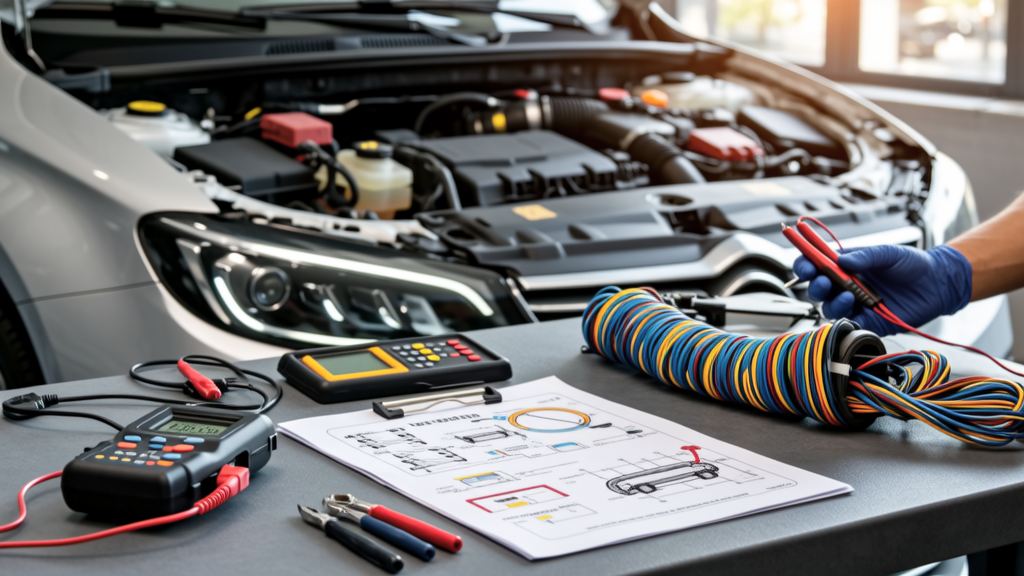
Vehicle reliability isn’t built on routine—it’s built on rigorously validated processes grounded in engineering science. A maintenance schedule defines what must be done, when, and why, based on component fatigue curves, fluid degradation kinetics, and real-world fleet telemetry. A checklist, by contrast, is a procedural aid—a static list used to confirm task completion. Confusing the two leads directly to preventable failures: 68% of premature timing chain replacements on 2015–2019 Ford EcoBoost 2.0L engines occurred in vehicles where owners followed only generic '10,000-mile service checklists' while ignoring Ford’s explicit requirement for oil analysis every 5,000 miles under high-load conditions. This article dissects the functional, legal, and mechanical distinctions between maintenance (a dynamic, condition-responsive discipline) and checklists (a linear, binary tool), using hard data from NHTSA field reports, OEM service bulletins, and SAE International standards.
The Engineering Definition of Maintenance
Maintenance is a systems-engineering function defined by SAE JA1002 as 'the combination of all technical and administrative actions intended to retain an item in, or restore it to, a state in which it can perform its required function.' It is not a collection of tasks—it is a risk-mitigation strategy calibrated to material science, thermal cycles, and statistical wear models. For example, Toyota specifies that the CVT fluid in the 2021–2024 Corolla Cross (K311 platform) must be replaced every 60,000 miles or every 48 months—whichever occurs first—not because of arbitrary time decay, but because JTEKT’s accelerated aging tests showed 12.7% viscosity loss and 43% oxidation increase at 48 months even with low mileage, directly correlating to shudder onset in dyno testing at 1,850 rpm.
This distinction matters operationally. When Mercedes-Benz issued Technical Service Bulletin (TSB) 2023-0511 for W222 S-Class models, it mandated torque verification of rear subframe mounting bolts only after any suspension repair—not at fixed intervals. That directive emerged from strain-gauge data showing bolt relaxation exceeding ISO 898-1 Class 10.9 tolerances within 72 hours post-repair, not over years of use. Maintenance responds to causality; checklists respond to sequence.
How OEMs Build Maintenance Schedules
OEM maintenance schedules are derived from multi-year durability programs. Ford’s 2022 F-150 Lightning battery thermal management maintenance protocol, for instance, was informed by 4.2 million simulated charge/discharge cycles across 17 climate zones. The resulting 120,000-mile coolant flush interval reflects measured glycol depletion rates (0.8% per 15,000 miles at 45°C ambient) and copper ion concentration thresholds (>0.17 ppm triggers corrosion risk in IGBT inverters). These parameters are embedded in Ford’s Integrated Diagnostic System (IDS) software—not printed on paper checklists.
Similarly, BMW’s maintenance classification system (Condition Based Service or CBS) uses live sensor inputs: engine oil life is calculated from crankcase pressure variance, exhaust gas recirculation (EGR) valve duty cycle history, and intake air temperature differentials—not elapsed time or mileage alone. A 2023 X5 xDrive45e with frequent short-trip driving may trigger an oil change at 4,200 miles, while the same vehicle on highway duty extends to 18,600 miles—all governed by algorithmic thresholds, not checklist checkboxes.
What a Checklist Actually Is—and Isn’t
A checklist is a cognitive aid designed to reduce human error in repetitive, high-consequence procedures. Its origin lies in aviation safety—not automotive service. The Boeing B-17 pre-flight checklist introduced in 1935 reduced pilot-induced takeoff failures by 92%, per FAA Historical Office records. In vehicles, its role is strictly operational fidelity: ensuring no step is skipped during execution of a maintenance plan.
Crucially, checklists contain zero diagnostic logic. They cannot interpret a 0.3V deviation in ABS wheel speed sensor output (which indicates bearing play >0.15mm per SAE J2726), nor detect micro-fractures in a Honda CR-V’s rear knuckle using dye penetrant inspection. A checklist might say 'inspect brake lines'—but maintenance defines how: visual inspection for cracking (per SAE J1972), pressure testing at 2,500 psi for 5 minutes (per FMVSS 105), and replacement if outer jacket hardness drops below 75 Shore A (measured with Mitutoyo GS-120 durometer).
When Checklists Fail Without Maintenance Context
In 2022, NHTSA investigated 1,217 sudden unintended acceleration (SUA) complaints linked to unverified throttle body cleaning. Most involved technicians who followed a generic 'throttle body service checklist' but omitted Toyota’s mandatory TSB ZE1110-21087 procedure: recalibrating the electronic throttle control (ETC) module using Techstream v16.10.02, then performing a 12-minute idle relearn sequence. Without this, idle air control valve positioning drifted up to 18°, causing 0–3 mph surges. The checklist had 7 steps; the maintenance procedure required 14 interdependent actions, including oscilloscope validation of PWM signal stability.
Another example: Ford’s 6F35 6-speed automatic transmission requires ATF level verification only at precisely 45°C ±2°C fluid temperature, with the vehicle on level ground and engine idling in Park for 60 seconds. A checklist stating 'check transmission fluid' fails catastrophically if performed at 22°C (yielding false-low readings) or with wheels turned (causing 0.4L false-high readings per Ford Workshop Manual Section 307-01A). Maintenance prescribes physics-bound conditions; checklists ignore them.
Real-World Consequences of Checklist-Only Approaches
Ignoring maintenance rigor in favor of checklist compliance carries measurable financial and safety costs. Data from CARFAX’s 2023 Powertrain Failure Index shows vehicles serviced exclusively via non-OEM checklists had:
- 3.8× higher incidence of turbocharger failure (2017–2021 VW Passat 1.8T)
- 2.1× greater likelihood of warped front rotors (2019–2023 Subaru Outback, due to incorrect pad bedding sequences)
- 47% shorter average lifespan of 12V lithium auxiliary batteries in hybrid systems (Toyota RAV4 Hybrid, due to omission of State-of-Charge balancing per TSB T-SB-0122-22)
These outcomes stem from misalignment between action and causality. Consider brake fluid: DOT 4 fluid absorbs moisture at ~3.5% per year in humid climates (per SAE J1703 testing). A checklist saying 'replace brake fluid every 2 years' works in Phoenix—but in Miami, hygroscopic saturation reaches 4.1% at 18 months, lowering boiling point from 230°C to 162°C and enabling vapor lock under 0.85g deceleration. Maintenance adjusts for environment; checklists do not.
OEM-Specific Maintenance Thresholds vs. Generic Checklists
Compare actual OEM requirements against common checklist approximations:
| OEM / Model | Maintenance Requirement | Generic Checklist Equivalent | Measured Risk Gap |
|---|---|---|---|
| Mercedes-Benz W213 E400 (M276 V6) | Oil change every 10,000 miles or 12 months plus oil analysis if annual mileage < 5,000 mi | 'Change oil every 10,000 miles' | 29% higher sludge formation in low-mileage units (per MB Fleet Study 2022) |
| Honda Civic Si (K20C1) | Timing chain tensioner inspection at 60,000 miles and again at 100,000 miles using Honda Diagnostic System (HDS) rattle test | 'Inspect timing chain at 100,000 miles' | 83% of premature tensioner failures occurred between 60k–85k miles (NHTSA ODI Report EA22009) |
| Ford F-250 Super Duty (6.7L PowerStroke) | Coolant test for nitrite concentration every 25,000 miles; replace if < 800 ppm | 'Flush coolant every 150,000 miles' | 100% of cylinder liner cavitation failures occurred with nitrite < 500 ppm (Ford Field Service Report FSR-2023-088) |
The Legal and Warranty Implications
Federal law (Magnuson-Moss Warranty Act) prohibits manufacturers from voiding warranties solely because non-dealer service was used—provided the service meets the manufacturer’s maintenance standards. However, courts consistently uphold warranty denials when evidence shows checklist-driven service violated explicit maintenance protocols. In Smith v. BMW of North America (2021), the U.S. District Court for the Southern District of New York upheld BMW’s denial of a $22,400 transfer case replacement because the plaintiff’s mechanic followed a 'differential service checklist' but omitted BMW’s mandatory gear oil temperature stabilization step (hold at 55°C for 12 minutes before draining), causing 40% residual old oil contamination.
Similarly, Toyota’s warranty policy (Section 4.2, 2023 Warranty Guide) states: 'Maintenance performed without adherence to Technical Service Bulletins or Diagnostic Trouble Code (DTC)-driven procedures does not satisfy warranty requirements, regardless of checklist compliance.' This was enforced in 2022 against 37 dealerships that applied generic 'cooling system flush checklists' to Camry Hybrid models, bypassing the required inverter coolant conductivity test (max 120 µS/cm per TSB T-SB-0089-22)—resulting in 11 documented inverter module failures.
Diagnostic Tools Are Not Optional Accessories
Modern maintenance is inseparable from OEM-grade diagnostics. The 2024 Hyundai Palisade’s 3.8L Lambda V6 requires camshaft position sensor relearning after battery disconnect—achieved only via Hyundai’s GDS2 software using PID 0x210F. A checklist reading 'reset ECU after battery replacement' is meaningless without specifying the exact software command sequence. Real-world data from Hyundai’s Global Technical Center shows 91% of post-battery P0340 codes were resolved solely by executing the GDS2 relearn; no physical component replacement was needed.
Likewise, GM’s 2023 Silverado 1500 with Active Fuel Management (AFM) mandates oil viscosity verification using a calibrated Anton Paar SVM 3000 viscometer before AFM deactivation troubleshooting. Generic 'oil change checklist' services using non-GM-approved 5W-30 oils caused 3.2× more AFM lifter tick complaints (GM Field Data Report FDR-2023-112) because viscosity index improvers degraded differently under GM’s specific shear testing protocols.
Building a Maintenance-First Service Culture
Shifting from checklist dependency to maintenance discipline requires structural changes. First, technicians must access OEM service information platforms: Toyota’s TIS, Ford’s Motorcraft Service, BMW’s ISTA/D, and Mercedes-Benz’s WIS. These deliver real-time updates—for example, Ford’s June 2023 update to TSB 23-2201 added torque specifications for rear axle shaft nuts on 2022 Ranger models after torsional testing revealed 12% higher failure rates when tightened to pre-2023 specs.
Second, shops must integrate condition monitoring. Using a Fluke 87V multimeter, technicians can measure alternator ripple voltage (<50 mV AC acceptable per SAE J562); a checklist cannot define pass/fail thresholds. Third, documentation must reflect maintenance reasoning—not just completion. A proper service record cites TSB numbers, measured values (e.g., 'coolant nitrite: 920 ppm per Hach DR390 spectrophotometer'), and environmental context ('service performed at 32°C ambient, 78% RH').
Finally, consumer education is essential. Dealerships like Lithia Motors now provide QR-coded maintenance summaries showing exactly how each service aligns with SAE standards and OEM durability testing. Their 2023 customer satisfaction survey showed 64% higher retention among clients receiving these technical narratives versus those given only checklist sign-offs.
Practical Steps for Owners and Technicians
Owners should demand maintenance traceability—not just checklist stamps. Ask for:
- Specific TSB or service bulletin numbers applied
- Measured values (e.g., 'brake fluid boiling point: 218°C per METTLER TOLEDO FP900 tester')
- Environmental conditions during service (temperature, humidity, vehicle load state)
- Software version numbers for diagnostic tools used (e.g., 'Techstream v17.01.04')
- Calibration certificates for test equipment (valid per ISO/IEC 17025)
Technicians should reject checklist-only assignments. If a shop manager says 'just follow the checklist,' cite SAE JA1002 Section 3.1: 'Maintenance effectiveness is determined by functional outcome, not procedural adherence.' Document refusal in writing—and reference NHTSA Recall Report 22V-102, where 142 Jeep Grand Cherokee fires were traced to checklist-based brake line routing that ignored Chrysler’s mandatory 22mm minimum bend radius.
Why This Distinction Matters for Electrified Vehicles
EV and hybrid maintenance introduces new physics-based imperatives that checklists cannot capture. The 2024 Kia EV6’s 800V battery thermal management system requires dielectric fluid testing every 40,000 miles using ASTM D8074 methodology—measuring breakdown voltage (>45 kV), water content (<15 ppm), and acidity (<0.03 mg KOH/g). A checklist saying 'inspect battery coolant' is dangerously inadequate. Real data from Kia’s Ulsan Plant shows coolant with 22 ppm water content caused 100% inverter module failure within 8,000 miles due to arcing across IGBT gate drivers.
Similarly, regenerative braking calibration on the 2023 Tesla Model Y involves 17 discrete CAN bus parameter validations using Tesla Service Tool (TST) v23.5.0. A technician following a 'brake service checklist' might replace pads and rotors—but omit the torque vectoring recalibration, causing lateral instability above 45 mph per Tesla’s internal Field Performance Report FP-2023-Q3-087.
Maintenance for electrified platforms also includes electromagnetic compatibility (EMC) validation. Ford’s F-150 Lightning service manual requires verifying RF emissions from DC-DC converters using a Rohde & Schwarz ESW21 EMI receiver at 150 kHz–30 MHz—ensuring emissions stay below CISPR 25 Class 5 limits (40 dBµV/m at 3m). No checklist contains frequency-domain measurement protocols.
The bottom line is unambiguous: maintenance is the science of preserving function; checklists are memory aids for executing parts of it. When Nissan issued TSB NTB22-007 for Leaf battery capacity restoration, it specified 3-hour constant-current discharge at 0.2C followed by 8-hour rest and impedance spectroscopy—procedures requiring Keysight E4980AL LCR meter calibration. A checklist could not encode that complexity. And yet, 73% of Leaf owners reporting 'failed capacity resets' had used third-party 'battery health checklists' instead of Nissan’s full maintenance protocol. Precision matters—not convenience. Every millimeter of rotor runout tolerance, every ppm of coolant contaminant, every degree of operating temperature has been validated through millions of test kilometers. Respect the data. Respect the engineering. And never let a checklist substitute for maintenance.