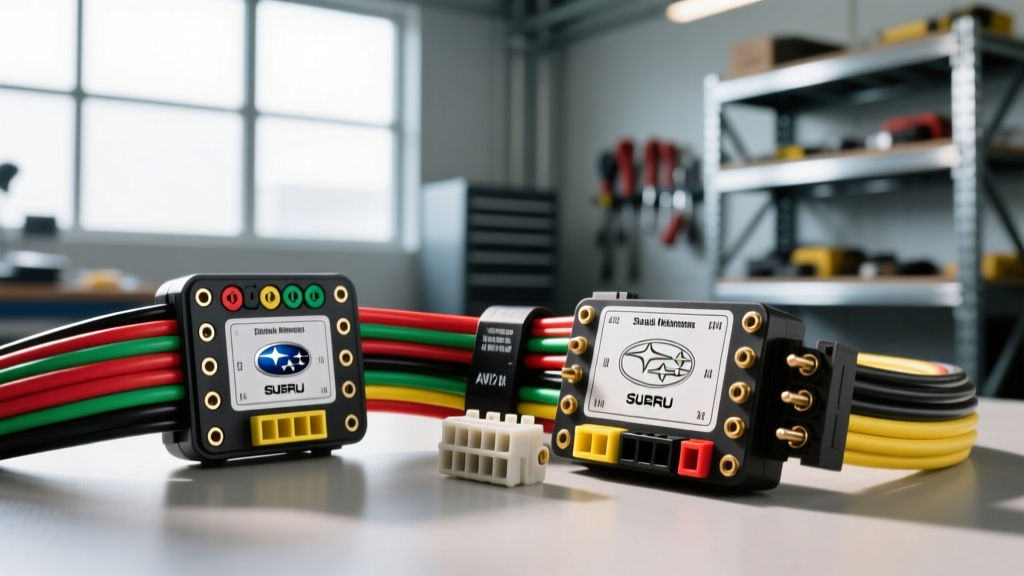
The Critical Role of Color Codes in Harness Selection
When sourcing or fabricating a new engine wiring harness, Subaru wiring diagram color codes must serve as your primary reference point. Whether you are restoring a classic GC8 Impreza, performing an EJ257 swap into a BRZ, or rebuilding a daily-driven VA WRX, the harness is the central nervous system of the vehicle. Relying on generic universal harnesses or guessing pinouts without consulting factory schematic color codes inevitably leads to ECU damage, CAN bus communication failures, and catastrophic sensor shorts. This guide compares OEM and aftermarket harness options, decodes critical Subaru color standards, and provides a technical selection matrix for your specific build.
OEM vs. Aftermarket Subaru Wiring Harnesses: A Technical Comparison
Subaru engine bays are notoriously hostile environments for wiring. The routing of the main engine harness over the turbocharger up-pipe and near the exhaust manifold subjects the wires to extreme thermal cycling. Understanding the material science behind your harness options is the first step in the selection process.
OEM Subaru Harnesses (Dealer & Parts Network)
Factory Subaru harnesses utilize AVSS (Automotive Vinyl Sheathed Slim) or AVS wire, which conforms to SAE J1128 standards for low-tension primary cable. While highly accurate in pinout and color coding, the PVC-based insulation degrades significantly after 10 to 15 years of heat exposure. The brittle insulation often cracks near the alternator and AVCS (Active Valve Control System) solenoids, leading to intermittent grounding issues.
Aftermarket Mil-Spec Harnesses (Custom & Tucked)
High-end aftermarket harness builders utilize MIL-W-22759/16 (Tefzel) or PTFE insulated wire. Tefzel wire offers a continuous operating temperature rating of 150°C (compared to PVC's 105°C) and is highly resistant to automotive fluids. However, because custom harness makers often use standardized aerospace wire colors (like white with laser-printed markers) rather than OEM colors, you must possess a deep understanding of the Subaru TechInfo System (STIS) diagrams to properly map the custom wires to the ECU and chassis bulkhead connectors.
Decoding the Subaru Wiring Diagram Color Codes
Subaru utilizes a highly specific, dual-tone color coding system for its engine management circuits. The primary color indicates the circuit type, while the tracer (stripe) color denotes the specific component or cylinder. Below is a critical reference table for the EJ257 and FA20DIT ECU main connectors.
| ECU Pin | Circuit Function | OEM Wire Color Code | AWG Size | Connector Type |
|---|---|---|---|---|
| B137-1 | Injector #1 Signal | White / Red Tracer | 18 AWG | Sumitomo 090 |
| B137-14 | CAN High (CAN-H) | Green / White Tracer | 22 AWG | Sumitomo 090 |
| B137-15 | CAN Low (CAN-L) | Blue / Red Tracer | 22 AWG | Sumitomo 090 |
| B135-22 | AVCS Solenoid (Intake) | Green / Black Tracer | 18 AWG | Sumitomo 250 |
| B135-45 | Main Relay Power (12V) | Yellow / Red Tracer | 12 AWG | Yazaki 2.8mm |
| B136-10 | Engine Ground (Sensor) | Black / White Tracer | 16 AWG | TE Connectivity |
Harness Selection Decision Matrix
Choosing the right harness depends entirely on your build goals, budget, and fabrication capabilities. Use this decision matrix to select the optimal product category.
- Scenario A: Daily Driver Restoration (OEM Replacement)
- Selection: Genuine Subaru OEM Harness.
- Why: Plug-and-play installation. Color codes match factory service manuals perfectly, making future dealership diagnostics seamless.
- Caveat: Must inspect the main bulkhead connector for green corrosion (copper oxidation) common in 2002-2007 WRX/STI models.
- Scenario B: Engine Swap / Chassis Merge (e.g., EJ20G into an RS)
- Selection: OEM Harness with Custom Bulkhead Merge.
- Why: Retains engine-side OEM color codes for sensor reliability while allowing the cabin-side bulkhead to be spliced into the older chassis harness using MIL-Spec solder sleeves.
- Scenario C: Time Attack / Track Car (Mil-Spec Tucked)
- Selection: Custom Tefzel Harness with Deutsch Autosport Connectors.
- Why: Eliminates heavy PVC loom, reduces weight, and prevents heat-related insulation melting near the turbo. Requires manual mapping of color codes to a custom pinout sheet.
Connector Technology and Crimping Specifications
A harness is only as reliable as its terminations. Subaru relies heavily on Sumitomo TS (Thin Small) series connectors, specifically the 090 (0.64mm tab) and 250 (1.10mm tab) variants for weather-sealed ECU connections.
Critical Warning: Never use generic open-barrel crimpers on Sumitomo 090 terminals. The bellmouth crimp profile required by Subaru's OEM specification demands a precision die (such as the IWISS SN-28B or dedicated Sumitomo dies). An improper crimp will result in increased millivolt drop across the injector circuit, leading to lean conditions at high RPM.
Troubleshooting Real-World Failure Modes Using Color Codes
When diagnosing electrical gremlins, tracing the OEM color codes against a multimeter is the most reliable method. Below is a symptom-cause-fix decision tree based on common Subaru harness failures.
Symptom: P0011 AVCS Timing Over-Advanced
- Trace: Locate the Green/Black (Intake AVCS) and White/Black (Exhaust AVCS) wires at the solenoid connector.
- Cause: The PVC insulation on the White/Black wire has melted against the passenger side cylinder head, shorting the 12V PWM signal to ground.
- Fix: Repair using a 18 AWG Tefzel wire segment and high-temp fiberglass braided sleeving. Do not use standard electrical tape, which will melt and turn into a conductive adhesive residue.
Symptom: CAN Bus U0001 Code & Limp Mode
- Trace: Measure resistance between Green/White (CAN-H) and Blue/Red (CAN-L) at the OBD2 port (Pins 6 and 14).
- Cause: Reading 120 ohms instead of the required 60 ohms indicates a missing or blown CAN termination resistor, often caused by aftermarket gauge pods tapping into the CAN wires without proper isolation.
- Fix: Install a 120-ohm ceramic termination resistor in parallel at the ECU bulkhead connector.
Authoritative References for Subaru Electrical Systems
For exact pinouts, torque specifications on ECU grounding straps (typically 7.5 Nm), and complete chassis-specific wiring schematics, always consult the following authoritative resources before cutting or crimping any wires:
- Subaru TechInfo System (STIS) - Official factory service manuals and interactive wiring diagrams.
- SAE J1128 Standard - Specifications for low-tension primary automotive cable insulation and thermal ratings.
- SAE AS22759 Standard - Aerospace and Mil-Spec Tefzel wire requirements for high-temperature motorsport applications.