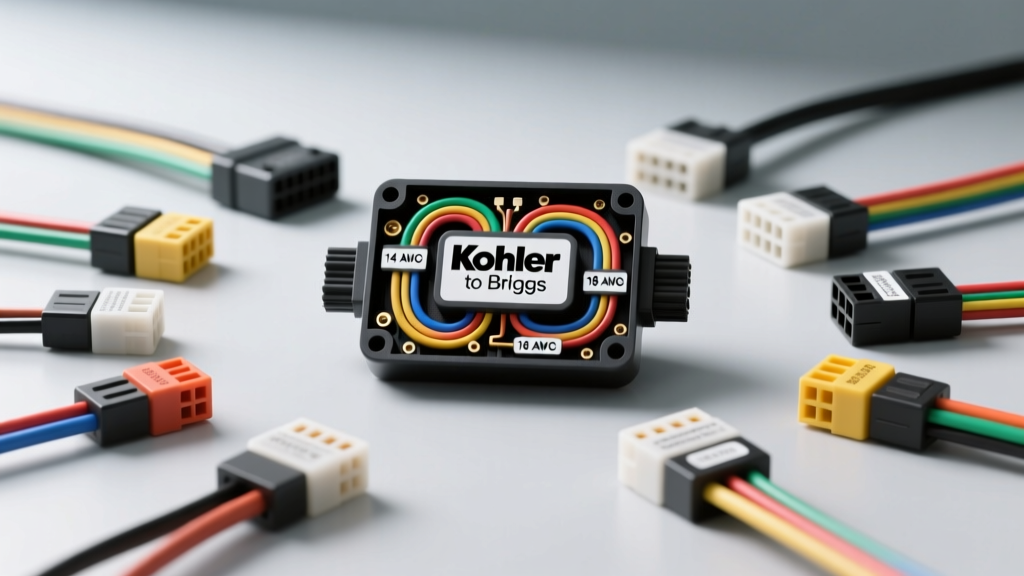
The Anatomy of a Kohler to Briggs Engine Swap
Swapping a failed Kohler Command or Courage engine for a Briggs & Stratton Vanguard or Intek is one of the most common repower procedures in the commercial landscaping and agricultural equipment sectors. However, the physical bolt pattern is only half the battle. The electrical architecture between these two manufacturers differs significantly in connector pin spacing, stator output regulation, and ignition kill circuit logic. A dedicated Kohler to Briggs wiring harness adapter is not merely a convenience; it is a critical safety and operational component that bridges the OEM chassis harness to the replacement engine’s electrical system.
Without the correct adapter harness, technicians risk catastrophic stator burnout, parasitic battery drains, and failure of the fuel shut-off solenoid. This guide compares the primary adapter harness solutions available on the market, details the exact wire gauge requirements, and provides a technical pinout matrix to ensure your engine swap is electrically sound.
Understanding the Electrical Mismatch
Before selecting an adapter kit, it is vital to understand why the OEM chassis plug will not mate directly with a Briggs & Stratton engine, even if the wire colors appear similar.
- Regulator/Rectifier Pinouts: Kohler typically utilizes a 3-pin or 4-pin Delphi-style connector for its voltage regulator, with specific placements for the AC stator inputs, the B+ battery charge wire, and occasionally an exciter/lamp circuit. Briggs & Stratton Vanguard engines use a different 3-pin or 4-pin housing with a different locking tab orientation and pin sequence.
- Ignition Kill Logic: Both engines generally use a "ground-to-kill" magneto shutdown method. However, the chassis harness relies on a specific pin location to route this ground signal. If the adapter harness maps the kill wire to the wrong pin, the engine will run indefinitely or fail to spark entirely.
- Fuel Solenoid Amperage: The anti-backfire solenoid on the carburetor bowl requires a solid 12V+ signal. Kohler solenoids typically draw 1.2A to pull and 0.6A to hold. Briggs solenoids can draw up to 1.8A on the initial pull. If the adapter harness uses undersized wire, voltage drop will cause the solenoid to chatter or fail to open, starving the engine of fuel.
Adapter Harness Categories: Which Kit Do You Need?
When sourcing a Kohler to Briggs wiring harness adapter, you will encounter three primary categories. Your selection depends on the specific zero-turn or tractor chassis (e.g., Scag, Exmark, Toro, John Deere) and the electrical load of your accessories.
1. OEM-Specific Plug-and-Play Adapter Harnesses
These are pre-loomed, direct-fit pigtails designed for specific chassis-to-engine combinations. For example, an adapter designed to plug a Scag Tiger Cat chassis harness into a Briggs Vanguard 35hp V-Twin. These kits feature exact OEM connector housings (often Molex MX150 or proprietary Delphi packs) and require zero cutting or crimping. They are the most reliable choice but carry a premium price tag and limited cross-compatibility.
2. Universal Regulator & Stator Pigtails
Universal kits provide the correct engine-side plugs for the Briggs stator and regulator, along with a length of SAE J1128 compliant low-tension primary cable. The installer must cut the OEM Kohler plugs off the chassis harness and splice them to the universal pigtail. While cost-effective, this method introduces splice points that are highly susceptible to moisture ingress and vibration-induced fatigue if not sealed with marine-grade heat shrink.
3. Heavy-Duty Solenoid Relay Harnesses (Custom Fabrication)
For older chassis where the OEM wiring has degraded, or for setups running high-draw electric PTO clutches, a standard adapter is insufficient. These kits include a 12V 30A Bosch-style relay, a fused B+ feed, and heavy-gauge pigtails. The relay uses the chassis’s weak 12V solenoid trigger wire to switch a direct, high-amperage feed from the battery to the Briggs fuel solenoid, eliminating voltage drop entirely.
Technical Pinout & Wire Gauge Reference Matrix
The following table outlines the critical wiring translations required when adapting a standard Kohler Command Pro twin-cylinder chassis harness to a Briggs & Stratton Vanguard twin-cylinder engine. Always verify against the specific Kohler service manuals and Briggs & Stratton wiring diagrams for your exact model numbers.
| Circuit Function | Kohler Chassis Side (Expected) | Briggs Engine Side (Actual) | Minimum AWG Requirement |
|---|---|---|---|
| Stator AC Output (Leg 1) | Yellow (Pin A) | White or Black (Pin 1) | 12 AWG |
| Stator AC Output (Leg 2) | Yellow (Pin B) | White or Black (Pin 2) | 12 AWG |
| Regulator B+ Charge | Red (Pin C) | Red (Pin 3) | 10 AWG |
| Ignition Magneto Kill | Purple (Pin D) | Gray or Black (Pin 4) | 16 AWG |
| Fuel Solenoid 12V+ | Red/White (Pin E) | Red (Inline Fuse) | 14 AWG (12 AWG Preferred) |
| Common Ground | Black (Chassis Ring) | Black (Engine Block) | 10 AWG |
Critical Selection Criteria: Stator Output & Regulator Matching
The most common point of failure in a Kohler to Briggs swap is mismatching the stator output to the chassis wiring capacity. Kohler Command engines frequently utilize a 15-amp or 20-amp stator to power electric PTO clutches and auxiliary lights. If your replacement Briggs Vanguard is equipped with a standard 9-amp stator, the adapter harness will physically connect, but the charging system will fail to keep up with the electrical load, leading to rapid battery depletion.
Conversely, if you are upgrading from a 9-amp Kohler to a 20-amp Briggs alternator system, the OEM chassis B+ charge wire (often 12 AWG) may overheat under sustained maximum load. When selecting your adapter kit, verify the amperage rating of the Briggs regulator. If the new engine outputs more than 15 amps, you must upgrade the adapter harness’s B+ red wire to a minimum of 10 AWG, and ensure the inline fusible link is rated for at least 25 amps to protect the chassis wiring from thermal runaway.
Upgrading the Fuel Solenoid Circuit (The Relay Solution)
Commercial zero-turn mowers endure immense vibration and heat, which degrades chassis wiring over time. A standard plug-and-play adapter harness relies on the chassis’s original 14 AWG or 16 AWG wire to carry the full amperage load of the Briggs fuel solenoid. Over a 6-foot run from the ignition switch to the carburetor, corrosion in the chassis connectors can easily drop the voltage from 12.6V to 9.5V.
At 9.5V, the Briggs solenoid plunger will not fully retract, causing a lean fuel condition and severe engine surging. To solve this, select an adapter kit that includes a solenoid relay upgrade. Wire the relay’s 85 and 86 pins to the chassis’s original solenoid trigger wire and a clean ground. Run a new 10 AWG fused wire directly from the battery positive terminal to the relay’s 30 pin, and use a 12 AWG wire from the 87 pin directly to the Briggs solenoid. This ensures the solenoid receives a full 12.6V regardless of chassis wiring degradation.
Connector Selection: Molex vs. Weather-Pack
When fabricating or modifying a universal adapter harness, the choice of connector housing dictates the lifespan of the swap. Avoid standard vinyl-insulated spade terminals or unsealed butt splices. The engine compartment of a commercial mower is exposed to high-pressure washdowns, grass clippings, and extreme thermal cycling.
Require your adapter harness to utilize either Delphi Weather-Pack or Molex MX150 sealed connector systems. These housings feature silicone radial seals that prevent moisture ingress directly at the wire crimp. Furthermore, ensure the terminal crimps utilize a matrix-grip or F-crimp profile rather than a simple dent crimp, which will loosen under the 3600 RPM vibration of a Vanguard V-Twin engine.
Real-World Failure Modes & Diagnostics
Even with the correct Kohler to Briggs wiring harness adapter, installation errors can lead to specific electrical faults. Use this diagnostic tree to troubleshoot post-swap issues:
- Symptom: Engine will not shut off when the key is turned to OFF.
Cause: The ignition kill wire is not achieving a solid ground. Fix: Verify the adapter harness has correctly mapped the chassis Purple (or White) kill wire to the Briggs magneto ground terminal. Check for paint or powder coating on the engine block where the ground ring terminal is secured. - Symptom: Battery is dead after sitting for 12 hours.
Cause: The regulator B+ wire is backfeeding current into the stator windings due to a blown internal diode or incorrect adapter pinout. Fix: Disconnect the adapter harness regulator plug. Use a multimeter to test for continuity between the B+ pin and the AC pins. If continuity exists in both directions, the regulator is faulty or the adapter harness has crossed the B+ and AC circuits. - Symptom: Fuel solenoid clicks rapidly but engine starves for fuel.
Cause: Severe voltage drop on the 12V+ solenoid feed wire. Fix: Measure voltage at the solenoid plug while the key is in the RUN position. If it reads below 11.5V, bypass the chassis wiring using the heavy-duty relay method outlined above.
Selecting the right Kohler to Briggs wiring harness adapter requires more than just matching plugs; it requires a fundamental understanding of small engine charging systems and chassis load requirements. By prioritizing sealed connectors, proper AWG sizing, and relay-integrated solenoid circuits, you ensure your repowered equipment operates with factory-level reliability.