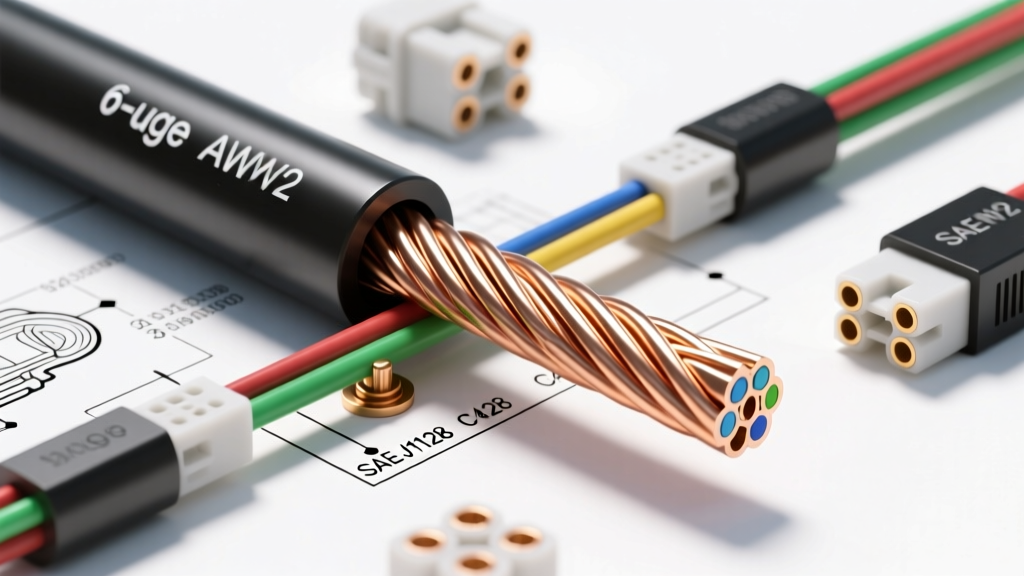
The Core Question: How Many Amps Does 6 Gauge Wire Carry?
When automotive electricians, off-road builders, and car audio enthusiasts ask, "how many amps does 6 gauge wire carry," the answer requires more nuance than a simple lookup table. In a strict automotive chassis wiring context, 6 AWG (American Wire Gauge) copper wire is rated to carry 60 amps. However, when used for power transmission over longer distances, or when bundled tightly in an engine bay harness, its safe continuous ampacity drops to 40 amps.
Unlike residential wiring governed by the National Electrical Code (NEC), automotive electrical systems operate on low-voltage, high-current DC principles. A 12-volt system requires significantly thicker conductors than a 120-volt household circuit to deliver the same wattage. To truly understand 6 AWG capabilities, we must examine the SAE International J1128 Standard for surface vehicle electrical cables, voltage drop tolerances, and insulation thermal limits.
Automotive Ampacity Specifications for 6 AWG
The physical construction of the wire dictates its current-carrying capacity. Automotive wire is heavily stranded to withstand the constant vibration and thermal cycling of a vehicle environment. Below are the precise engineering specifications for standard 6 AWG SGT (Standard General Purpose Thermoplastic) battery and primary cable.
| Specification | 6 AWG SGT Automotive Wire |
|---|---|
| Cross-Sectional Area | 13.30 mm² |
| Stranding Configuration | 133 strands / 0.0100" (0.254mm) each |
| Nominal Outside Diameter (O.D.) | 0.204" (5.18 mm) |
| DC Resistance @ 20°C (68°F) | 0.410 Ω / 1,000 ft |
| Max Ampacity (Chassis / Free Air) | 60 Amps |
| Max Ampacity (Power Transmission / Bundled) | 40 Amps |
| Max Operating Temperature (SGT Insulation) | 105°C (221°F) |
The Danger of Copper Clad Aluminum (CCA)
When sourcing 6 AWG wire for high-load automotive applications like winch relays or secondary power distribution blocks, you must verify the metallurgy. Many budget brands sell CCA (Copper Clad Aluminum) wire. Aluminum has only 61% of the conductivity of pure oxygen-free copper (OFC). A 6 AWG CCA wire will exhibit the resistance of roughly 8 AWG copper wire, leading to severe voltage drop, excessive heat generation, and potential fire hazards under a 60A continuous load. Always specify OFC or bare copper conforming to Southwire's automotive cable specifications or equivalent SAE J1128 standards.
Voltage Drop: The Real Limiting Factor in 12V Systems
Knowing how many amps 6 gauge wire can carry thermally is only half the battle. In a 12V or 24V vehicle, voltage drop is usually the limiting factor before the wire reaches its thermal melting point. Automotive electronics, sensors, and high-output alternators require stable voltage. A generally accepted maximum voltage drop for critical power feeds is 3% (0.36V on a 12V system).
The formula for calculating voltage drop in a DC circuit (accounting for both the positive and negative ground return path) is:
VD = (2 × L × I × R) / 1000
- VD = Voltage Drop
- L = One-way length of the wire in feet
- I = Current in Amps
- R = Resistance per 1,000 ft (0.410 for 6 AWG)
12V System Voltage Drop Chart for 6 AWG Wire
| Current (Amps) | 10 ft Run | 20 ft Run | 30 ft Run |
|---|---|---|---|
| 20A | 0.16V (1.3%) | 0.33V (2.7%) | 0.49V (4.1%) |
| 40A | 0.33V (2.7%) | 0.66V (5.5%) | 0.98V (8.1%) |
| 60A | 0.49V (4.1%) | 0.98V (8.1%) | 1.48V (12.3%) |
Analysis: If you are running a 60A continuous load (such as a heavy-duty cooling fan setup or a high-amperage DC-DC charger for an overland camper), a 10-foot run of 6 AWG wire yields a 4.1% drop. To maintain a strict 3% drop at 60 amps, your total one-way wire length cannot exceed 7.3 feet. If your run is 20 feet, you must step up to 2 AWG or 1/0 AWG wire, regardless of the 6 AWG thermal ampacity rating.
Insulation Types: SGT, SGX, and TXL
The ampacity of 6 gauge wire is also heavily influenced by the insulation jacket, which dictates how much heat the wire can safely dissipate and resist before melting or shorting against the chassis.
- SGT (Standard General Thermoplastic): PVC insulation rated to 105°C. Thicker jacket, highly resistant to physical abrasion. Best for battery-to-starter runs and under-hood primary feeds where physical damage is a risk.
- SGX (Cross-Linked Polyethylene): XLPE insulation rated to 155°C. Highly resistant to high engine bay temperatures, chemicals, and battery acid. The industry standard for premium automotive harnesses.
- TXL (Thin-Wall Cross-Linked): Rated to 125°C but features a significantly thinner outer jacket, reducing overall O.D. and weight. Used extensively in modern OEM wiring harnesses where 6 AWG is routed through tight firewall grommets and enclosed plastic looms.
Real-World Automotive Applications for 6 AWG
Based on the thermal and voltage drop data, here is how 6 AWG wire is correctly applied in advanced automotive builds:
- High-Output Alternator Upgrades: On platforms like the 1999-2006 Chevy Silverado (GMT800), the factory 10 AWG alternator charge wire is insufficient for aftermarket 200A+ alternators. While a 1/0 AWG main feed is ideal, dual 6 AWG wires (run in parallel) are frequently used to route power from the alternator post to the under-hood fuse block and secondary distribution busbars.
- Car Audio Power Distribution: For a high-efficiency Class-D amplifier producing 800W RMS (drawing roughly 65A at peak), a 4 AWG main feed is used from the battery to a distribution block. From the distribution block to the amplifier's terminal (usually a 3-foot run), 6 AWG is perfectly suited and easily fits into the amplifier's set-screw power terminals.
- EV Battery Module Interconnects: In custom electric vehicle conversions and Tesla module balancing systems, 6 AWG SGX wire is used for intermediate high-voltage contactor feeds and heavy-duty 12V accessory bus routing.
- Heavy-Duty Lighting Relays: Off-road vehicles running 4 to 6 high-draw LED light bars (totaling 40-50 amps) utilize 6 AWG wire from the battery to the main relay block, ensuring full 13.5V+ reaches the relay coils and high-current pins.
Termination and Crimping Standards
A 6 AWG wire carrying 60 amps is only as reliable as its termination. Improper crimping introduces transition resistance, which generates localized heat. For 6 AWG wire, standard stamped brass terminals are unacceptable.
You must use heavy-duty copper ring terminals (typically 1/4" or 5/16" stud size) and an indent or hex-crimp tool. Hex crimping deforms the terminal and wire into a solid hexagonal shape, cold-welding the copper strands together and eliminating air pockets where oxidation could occur. Following the crimp, the termination must be sealed using dual-wall adhesive-lined heat shrink. The inner meltable adhesive layer prevents moisture from wicking into the copper strands via capillary action—a common failure mode in marine and off-road environments that leads to green corrosion and increased resistance.
Summary Reference
To summarize, 6 gauge pure copper wire safely carries 60 amps in short, free-air chassis runs, and 40 amps in bundled power transmission applications. However, in 12V automotive systems, voltage drop calculations must supersede thermal ampacity charts. Always verify your wire is OFC (not CCA), utilize SAE J1128 compliant insulation (SGX or TXL), and terminate with hex-crimped, adhesive-sealed heavy-duty lugs to ensure a reliable, fire-safe electrical system.
For further reading on electrical safety and standard compliance, refer to the NFPA 70 National Electrical Code for baseline electrical principles, and always cross-reference with your specific vehicle manufacturer's service manual for OEM routing and derating guidelines.